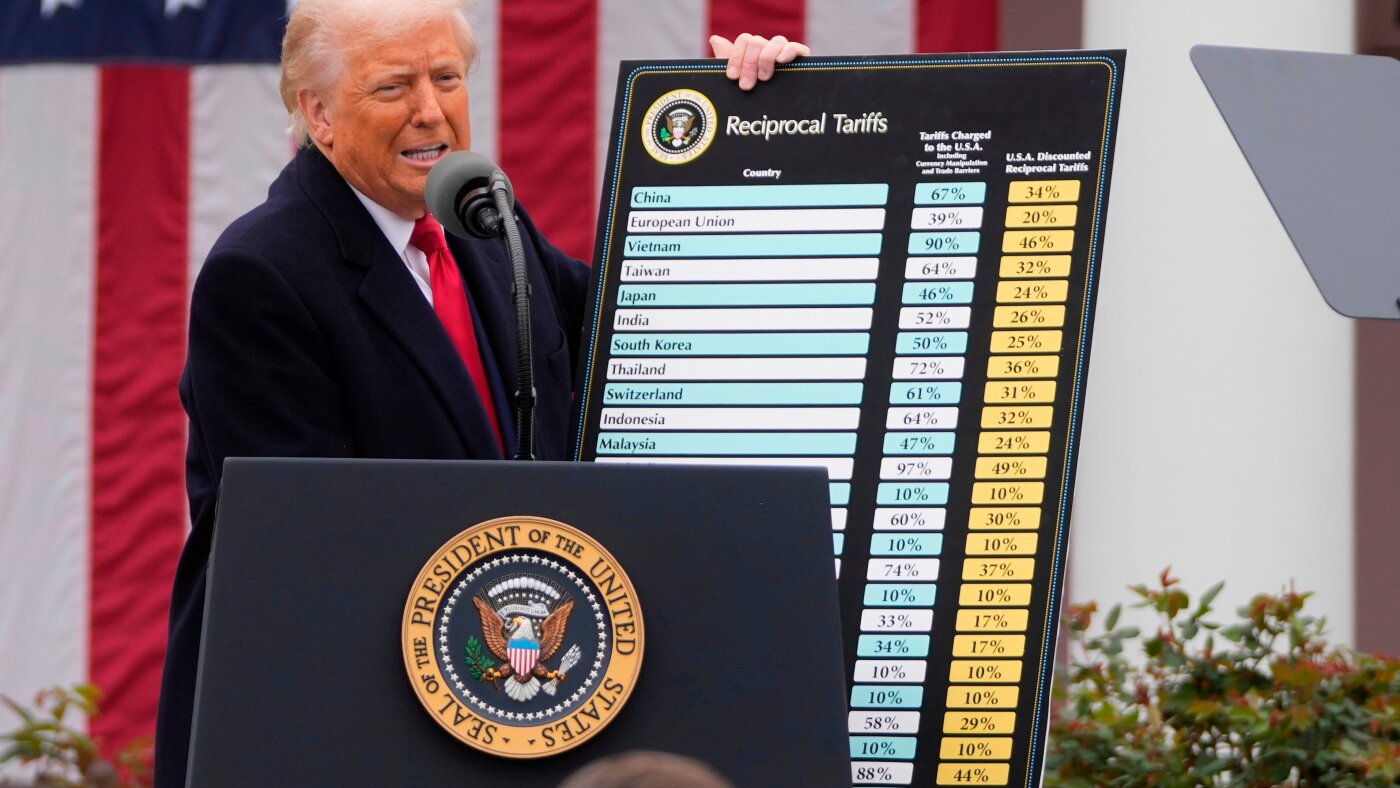
President Trump speaks during an event to announce new tariffs in the Rose Garden at the White House on April 2, 2025.
Mark Schiefelbein/AP
hide caption
toggle caption
Mark Schiefelbein/AP
Many of America’s key allies on Friday criticized the U.S. administration’s new tariffs against them, after President Trump renewed the tax on imports from more than 60 countries just as the previous tariffs expired.
The U.S. Supreme Court had ruled earlier this year that many of the tariffs imposed under emergency powers were unconstitutional.
The president cited lax enforcement of a ban on the use of forced labor to produce goods as his reason for renewing the tariffs, an allegation Australia and the European Union vehemently rejected.
Those targeted with the latest penalties face between 10% and 12.5% on many of their exports to the U.S., although various countries have trade deal exemptions for certain sectors.
“Trading partners that have made commitments to adopt, and effectively enforce, forced labor import prohibitions will have a 10% tariff, and trading partners that have failed to adopt a forced labor import prohibition will have a 12.5% tariff rate,” according to the Office of the U.S. Trade Representative.
Here are some reactions from around the world:
Australia and New Zealand
Australian Trade Minister Don Farrell said the 12.5% tariffs on his country’s exports to the U.S. were “unjustified” and called it “an extremely disappointing decision.”
“We believe we do take the issue of modern slavery seriously. We have some of the most progressive legislation anywhere in the world. We say that these tariffs are unjustified and we call on the United States government to reverse them,” Farrell said to Sky News.
In New Zealand, Prime Minister Christopher Luxon called the tariffs “extremely disappointing.”
“The U.S. investigation did not provide meaningful evidence to support claims in relation to forced labour. Tariffs are not the way — they drive up costs and uncertainty for businesses,” he said online.
European Union and the United Kingdom
The EU’s foreign policy chief, Kaja Kallas, also questioned Trump’s rationale for the new tariffs.
“If you compare our labor laws to the ones of the United States, I mean, we have, people have paid vacations, we have very good conditions, labor conditions, for our employees, so it’s not really grounded,” she told Reuters.

Shipping containers are seen ready for transport at the Guangzhou Port in the Nansha district in southern China’s Guangdong province, April 17, 2025.
Ng Han Guan/AP
hide caption
toggle caption
Ng Han Guan/AP
The British government said Trump’s latest 10% tariffs will amount to “no negative change” for British exports. Former Prime Minister Keir Starmer was able to strike a better U.S. trade deal than many other countries, with lower tariff rates. And King Charles III got the U.S. tariff on Scotch whisky reduced to zero when he visited the White House in April.
But the British government said in a statement: “We take forced labour very seriously to ensure that in global supply chains U.K. businesses are not complicit.”
Asia
The world’s second-largest economy, China, was hit with 12.5% new tariffs and the Foreign Ministry condemned the move.
“Tariff wars and trade wars do not serve any parties’ interests,” ministry spokesman Lin Jian told a regular press conference on Friday.
Japan will also see 12.5% tariffs on exports to the U.S. Japanese Chief Cabinet Secretary Minoru Kihara said his country had been reassured by the Trump administration that its goods would not be slapped with more tariffs.
“It is regrettable that the measure imposes tariffs on the grounds of nonexistence of measures banning imports of goods made by forced labor, even though Japan’s industry and trade are in line with international rules,” he said.
Latin America
Trump’s latest tariffs stacked a 12.5% duty on many imports from Brazil — just days after putting 25% tariffs on Brazilian goods.
Brazilian President Luiz Inácio Lula da Silva said in a statement that his government “rejects” the measure, saying the U.S. “manipulated” human rights issues to support a “protectionist trade policy.” He said Brazil has ratified dozens more international labor treaties than the United States has.
Trump has often tussled with Brazil’s left-wing government. But other South American countries with more pro-Trump presidents, including Chile, also got the higher 12.5% tariff.
The U.S. slapped a 10% tariff on its top trading partner Mexico. But Mexican Economy Minister Marcelo Ebrard said his country will see no change since there has already been a 10% tariff, and more than 80% of Mexico’s exports to the U.S. enter duty free under the U.S.-Mexico-Canada Agreement.
Lauren Frayer contributed to this story from London, Kristina Kukolja contributed from Melbourne, Australia, and Catherine Osborn contributed from Rio de Janeiro.