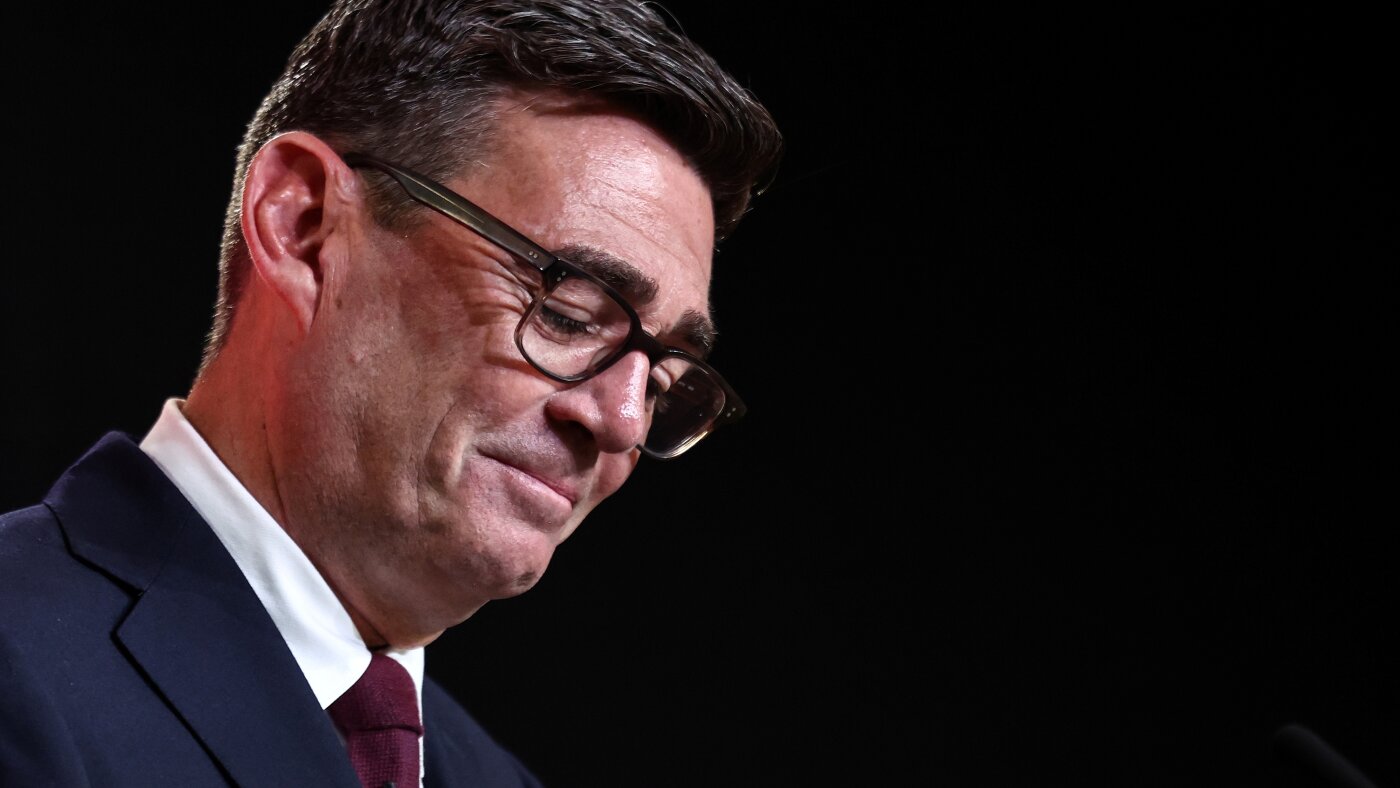
Britain’s new Prime Minister Andy Burnham after being confirmed as Labour Party leader at Labour’s Special Conference in central London on Friday, July 17, 2026, ahead of taking office Monday.
Henry Nicholls/Pool AFP via AP
hide caption
toggle caption
Henry Nicholls/Pool AFP via AP
LONDON — Keir Starmer is out, Andy Burnham is in.
On Monday, outgoing Prime Minister Starmer traveled to Buckingham Palace to tender his resignation to King Charles III. Shortly afterwards, his successor, Andy Burnham, will make the same journey and be invited by the King to form a new government.
Burnham becomes the U.K.’s seventh prime minister in a decade, since Britons voted in June 2016 to leave the European Union. That decision ultimately shrank the British economy, triggered anger at the governing class, and contributed to a revolving door of prime ministers.
Starmer exits after two years
Starmer delivered his final speech outside 10 Downing Street earlier on Monday before heading to Buckingham Palace to formally resign as prime minister, declaring: “My work is done.”
“In six and a half years I took our party from a historic defeat in 2019, changed it so it was fit to face the country, and won a landslide general election victory in 2024,” Starmer said. He described serving as prime minister as “the privilege of my life” and said he was leaving office confident Britain was “stronger and fairer” than it was two years ago.

Britain’s King Charles III welcomes outgoing Prime Minister Keir Starmer during an audience at Buckingham Palace in London, Monday, July 20, 2026, where Starmer formally tendered his resignation as prime minister.
Aaron Chown/Pool Photo via AP
hide caption
toggle caption
Aaron Chown/Pool Photo via AP
Closing his final address outside Downing Street, Starmer said, “I go with good grace, I go with a smile, and I go proud of everything we have achieved.”
Starmer led the U.K.’s center-left Labour Party to a landslide victory two years ago. But his personal approval ratings sank. Polls show voters believe he failed to deliver palpable change. He was also criticized for appointing Peter Mandelson, a close friend of the late sex offender Jeffrey Epstein, as British ambassador to Washington. Starmer later fired Mandelson.
After Labour lost seats to a populist anti-immigration party in May’s local elections, more of Starmer’s own lawmakers joined calls for his removal.
Starmer resigned as Labour leader June 22, and Burnham assumed that role Friday. Under Britain’s parliamentary system, the ruling party can replace its leader — and therefore the prime minister — without a general election. The next election is not expected for another three years.
Burnham is no stranger to national politics
Burnham previously served as a Member of Parliament for 16 years, holding several cabinet roles in the Labour governments of Tony Blair and Gordon Brown. He ran twice for the Labour leadership, receiving a nomination from Starmer during the 2015 contest, before leaving Parliament to become mayor of Greater Manchester.
As mayor, Burnham championed investment and devolution in the post-industrial region, and has pledged to bring a similar approach to the U.K. nationally. He returned to Parliament in a special election last month.
Standing outside Downing Street as prime minister Burnham said
Born and raised in the grittier north of England, Burnham has cultivated a working-class hero vibe, often wearing T-shirts rather than suits, and advocating for blue collar workers. He moonlights as a D.J. on Manchester’s indie music scene. His social media videos have been compared to New York Mayor Zohran Mamdani’s.
Polls show he’s one of the most popular U.K. politicians.
In terms of policy, Burnham has said he’ll scrap plans for digital ID cards, reverse the privatization of public transit and utilities, and devolve power away from the capital London, toward municipal and regional authorities.
In recent days, there have been reports that Burnham might ease a ban on new drilling for oil and gas in the North Sea — which won him immediate praise from President Trump on social media on Sunday. Trump wrote that with North Sea drilling, Burnham would transform the U.K. from “a Poverty Stricken Disaster, to one of the Richest Countries anywhere in the World!”
But Burnham is likely to face some of the same challenges that stymied Starmer: Rising costs of living, slow growth, and that volatile American ally across the Atlantic.