A year ago, most Wisconsin residents thought little about data centers, according to local leaders and journalists.
But today, the computing facilities — and where they get their energy — are a key issue in the hotly contested Aug. 11 Democratic primary for Wisconsin governor.
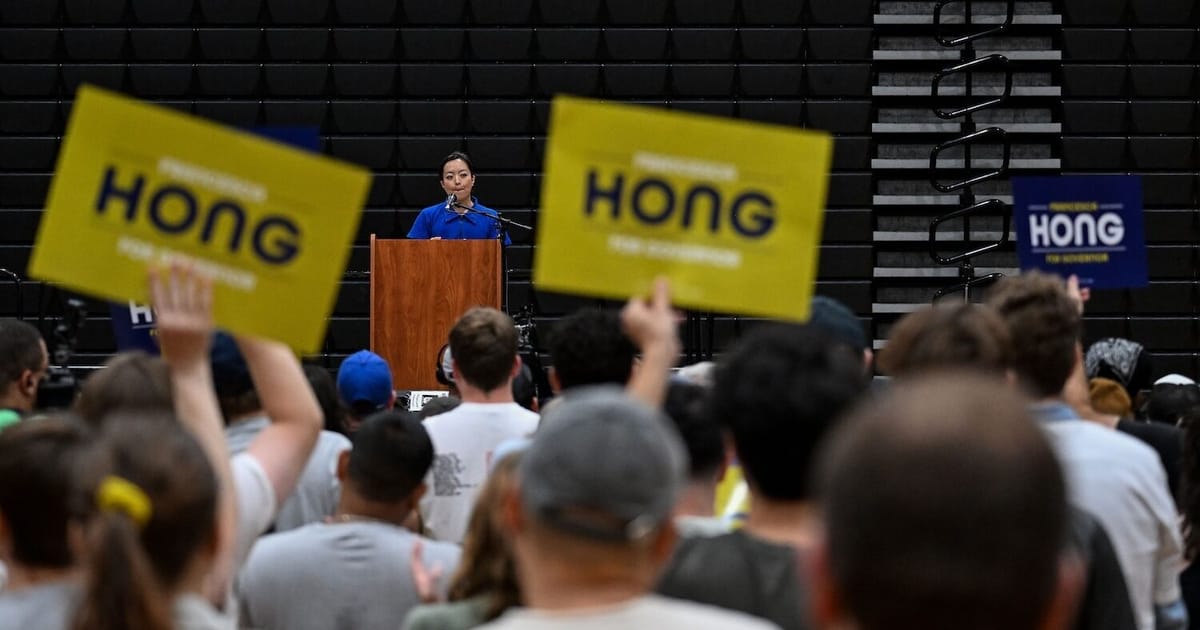
At a lively town hall last week in Milwaukee, five Democratic candidates vied to outdo their peers in tough talk about data centers and their developers, described as “Big Tech oligarchs” by state Rep. Francesca Hong, the leading contender according to recent polling.
Whoever wins the nomination will run against Tom Tiffany, the Republican candidate on the ballot in November and a current U.S. representative for north and central Wisconsin. He too has focused part of his campaign on curbing data centers, promising to prevent the use of farmland for the facilities and repeal tax breaks for them. But unlike the Democratic hopefuls arguing that AI facilities should be powered largely by clean energy, Tiffany is pushing state regulators to keep decades-old coal plants online past their retirement dates to help meet ballooning power demand.
While data centers are an increasingly hot-button topic nationwide in the run-up to the November elections, the tension is particularly pronounced in Wisconsin as developers have recently flocked to the state, drawn by its cool climate, access to water, robust transmission and generation infrastructure, and generous tax incentives passed by the Republican-dominated legislature and signed by current Democratic Gov. Tony Evers in 2023.
That’s spiked public fears about the facilities’ impacts, including that the boom in energy demand will drive a buildout of polluting power plants and increase household utility bills. A July 22 Marquette University Law School poll found that over three-quarters of Wisconsin voters say the costs of data centers outweigh the benefits, up from 55% in October 2025. Almost nine out of 10 Democrats and two-thirds of Republicans who answered the poll held this viewpoint.
“This story isn’t going away. It will only grow in importance to people,” said Elizabeth Ward, director of the Sierra Club’s Wisconsin chapter. “People are worried about air pollution, water pollution, land impacts, especially when gas plants are being built just to serve data centers. We hope to have a strong governor who passes safeguards against them.”
How the candidates want to curb data centers
All the Democratic candidates at the data center–focused town hall vowed to keep the industry on a tight leash and ensure that community protections are enforced by the legislature, governor’s office, utility regulators, and state agencies.
While none of the other candidates support a moratorium, each says they would aggressively pursue ratepayer protections and clean energy investments from data centers and utilities that serve them.
Hong calls her data center plan “Control-Alt-Delete,” and her website says that “if a community decides it wants to proceed with data center construction, it needs to be powered by clean energy.” She says taxes paid by data center developers should be invested in a green bank to fund energy and climate solutions, and utilities should be forced to report how much energy large customers use, to ensure regular customers aren’t footing the bill. Hong also advocates for the expansion of public utilities, which her campaign says currently provide 11% of the state’s power and charge significantly lower prices than We Energies does.
Joel Brennan, a civic leader and former official in Evers’ administration, wants to make data centers invest in larger transmission upgrades and clean energy. At the town hall, he said the legislature needs to pass a law codifying the commitment to 100% carbon-free energy by 2050 that Evers set with a 2019 executive order. He also said data centers should use battery storage instead of diesel generators for backup power.
Milwaukee County Executive David Crowley said he’d order data centers to bring their own 100% clean energy to the grid. Crowley had dropped out of the race July 8, then reentered 10 days later, and won Evers’ endorsement when another candidate — Lieutenant Gov. Sara Rodriguez — withdrew.
State Sen. Kelda Roys pledged to work with the legislature to “immediately pass” a bill introduced by Democrats in the last session that would — among other things — require data centers to get at least 70% of their energy from renewables in order to qualify for tax breaks. (Republicans backed a separate data center bill in the last session that likewise did not advance.)
Roys previously told the Milwaukee Journal Sentinel, which sponsored the town hall, that she would require “significant upfront payments from large data center projects, hundreds of millions of dollars each, to capitalize a public clean energy infrastructure bank,” which would provide zero-interest revolving loans for clean energy upgrades to public buildings.