
He noted that, in some markets, developers and utilities are striking long-term agreements for “firm,” or on-demand, power that are two to three times higher than they were in 2021, incentivizing more geothermal companies to pursue new projects.
The recent momentum is also thanks to the geothermal drilling advances that have emerged in the years since Ormat launched its first Desert Peak pilot.
Fervo Energy, for example, uses horizontal drilling techniques and fiber-optic sensing tools from the oil and gas industry to fracture hard, impermeable rocks and create artificial reservoirs. In 2023, the Houston-based startup turned on a first-of-a-kind enhanced geothermal system in Nevada. The 3.5-MW project sends electricity to the grid to help satisfy some of Google’s power appetite in the state.
Simultaneously, Fervo has been developing its 500-MW Cape Station project in Utah, which is set to become the world’s largest enhanced geothermal system when fully completed, potentially by 2028. While developing the project, the company said it reduced drilling times by about 75% and slashed per-foot drilling costs by about 70% between 2022 and 2025, marking a significant achievement for the nascent industry.
To fund its scale-up, the nine-year-old company in May became the first next-generation geothermal firm to go public, netting about $1.9 billion. (Ormat, which hit almost $1 billion in revenue in 2025, joined the stock exchange back in 2004.)
The startup Quaise Energy recently credited Fervo’s IPO with giving it a fundraising boost. Quaise raised $134 million this month to advance its first superhot geothermal project near an Oregon volcano. The company XGS Energy, which is pursuing a novel closed-loop technology, has been hiring veteran finance executives as it evaluates going public itself.
“Fervo definitely led the way, in terms of showing a path to the public equity markets for pre-revenue development companies like us,” said Richard Chong, who joined XGS in May as the company’s chief financial officer. Chong previously worked at Calpine, where he helped secure over $2 billion in financing to expand The Geysers, a decades-old geothermal development in Sonoma County, California.
Old-school geothermal gets a boost, too
The enthusiasm for cutting-edge technologies is spilling over into the conventional geothermal market, which has grown at a tortoise-like pace in recent years.
Hydrothermal resources are generally easier and less expensive to tap, since they don’t require fracking deep underground. But scientists and companies have explored only a tiny fraction of America’s subsurface geothermal resources. For any developer, it can cost tens of millions of dollars just to do the preliminary drilling to locate those resources — and to confirm that they’re good enough to produce electricity for decades. Such an undertaking was harder to justify in the years when U.S. electricity demand was essentially flat.
Now, “the market conditions around electricity demand have driven a lot of developers to rethink their portfolios and their assumptions on if they should develop,” O’Connor said.
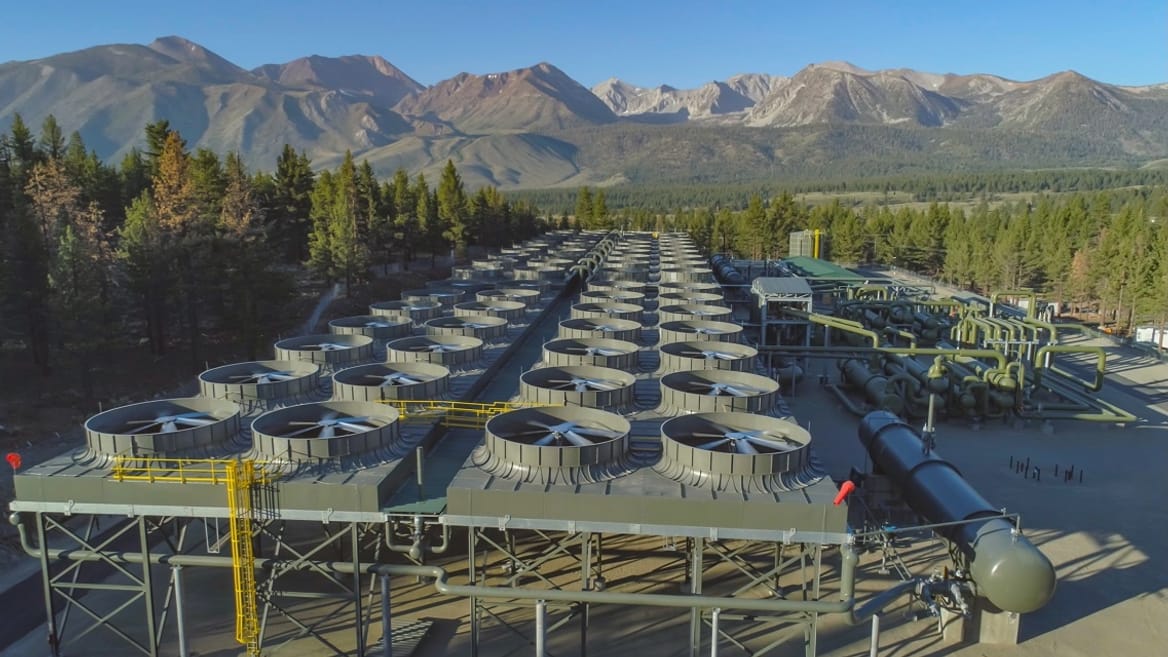
In June, Ormat received expedited approval for environmental permits from the Bureau of Land Management to begin developing the new 60-MW Pearl Geothermal Development Project on public lands in Esmeralda County, Nevada. The approval stems from the Trump administration’s 2025 emergency permitting procedures to accelerate energy development on federally managed lands — on which over 90% of identified U.S. geothermal resources are located.
The bureau has also awarded permits for Ormat’s other initiatives in Nevada, including the 30-MW Crescent Valley plant and the earlier-stage Diamond Flat and Pinto project sites, where the company will study and test for geothermal resources. All told, Ormat holds leases to some 400,000 acres across six states.
“Ormat has gone from a company that was focused on operating the assets it currently has to thinking about expanding, and they are not alone,” O’Connor said.
The startup Zanskar raised $40 million in April to build its first conventional geothermal plant. The company combines artificial intelligence with boots-on-the-ground surveying to identify hidden natural resources in the U.S. West. Last year, Zanskar said it had identified the first “blind” geothermal system — meaning it doesn’t have vents, geysers, or other visible features, or any historical records — for commercial use in more than 30 years.
“They’re taking advantage of the higher demand for the lower-hanging fruit,” O’Connor said of Zanskar’s conventional geothermal play. The startup and other firms “are either acting on leases that people have held for a while and not had motivation to use, or exploring for the first time.”
Ormat, for its part, will continue to rely on its “robust hydrothermal business” while also piloting the next-generation technologies that could enable geothermal to leave behind its niche position in the global energy market, Ormat’s Moelk said.
“Right now, we have what the world needs: renewable, local, baseload energy,” he said. “After 20 years in geothermal, I’ve never seen such a big opportunity.”


