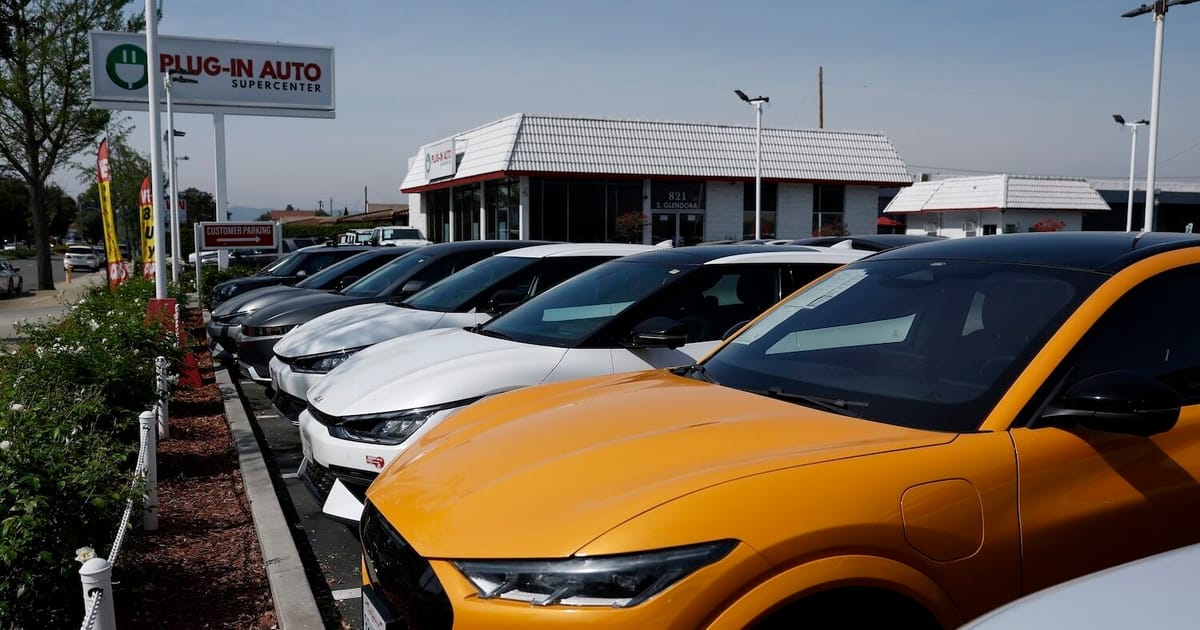
California is making a bet: Once you’ve driven an EV, you won’t want to go back to a gas-powered car.
Earlier this month, Gov. Gavin Newsom (D) signed legislation creating the MyFirstEV program. It’s the state’s first big attempt to make up for the loss of federal EV tax credits, and it’s exclusively targeting the key demographic of EV neophytes.
The fine details are still being hashed out in advance of MyFirstEV’s official launch later this summer. But, in broad strokes, the program will offer a $3,500 rebate at the point of sale for a first-time purchase or lease of any new EV that retails for $50,000 or less, and a $1,750 rebate for a used EV selling for $25,000 or less.
The program is funded with $270 million. Half of that will come from the state budget, and the other half — in a rare arrangement — will come from participating automakers, including Ford, General Motors, Honda, Hyundai, Kia, Lucid, Mitsubishi, Nissan, Rivian, Subaru, Tesla, Toyota, and Volvo.
For years, consumers across the nation could get discounts of up to $7,500 for new EVs and up to $4,000 for used EVs. These tax credits were crucial: They could make some new EVs cost-competitive with new fossil-fueled cars.
That poses problems for decarbonization goals held by states like California, as fossil-fueled vehicles are among the largest sources of greenhouse gas emissions in the nation.
California’s new program is notable both because it is by far the nation’s largest EV market and because it’s the first to tie rebates to first-time EV buyers.
That’s according to Rachel Reolfi, senior policy analyst at research firm Atlas Public Policy. She made the case for strategies like MyFirstEV in a December policy paper that argued states will get more “bang for the buck” if they limit incentives to first-time buyers.
As Reolfi told Canary Media, this “pretty novel concept” makes sense because of a simple fact: “When folks buy an EV, they don’t go back to gas cars.”
Survey data supports the point. J.D. Power’s February consumer satisfaction survey shows that 96% of U.S. EV owners would consider purchasing or leasing another EV for their next vehicle. Concerns about range and charging availability also drop significantly once a person starts driving an EV, per analysis from EV-advocacy group Plug In America.
This data helped inform California’s MyFirstEV program, said Dan Krassner, executive director of EVs for All America, a nonprofit research group that commissioned the Atlas report.
By focusing scarce state funds on first-time EV buyers, “each rebate buys a customer rather than a transaction,” Krassner said in an email. American EV Jobs Alliance, his group’s advocacy affiliate, “took that concept into California and made the case for it with lawmakers, the administration, and coalition partners.”
This approach makes sense, according to Corey Cantor, research director at the Zero Emission Transportation Association trade group. “When you leave the early adopters behind and try to hit mass market scale, we know up-front price and charging concerns have been a challenge,” he said. “The people we really need to reach are those that have yet to be convinced to drive electric.”
How to make the most of tight state EV-rebate budgets
Restricting rebates to first-time EV buyers does add some complications.