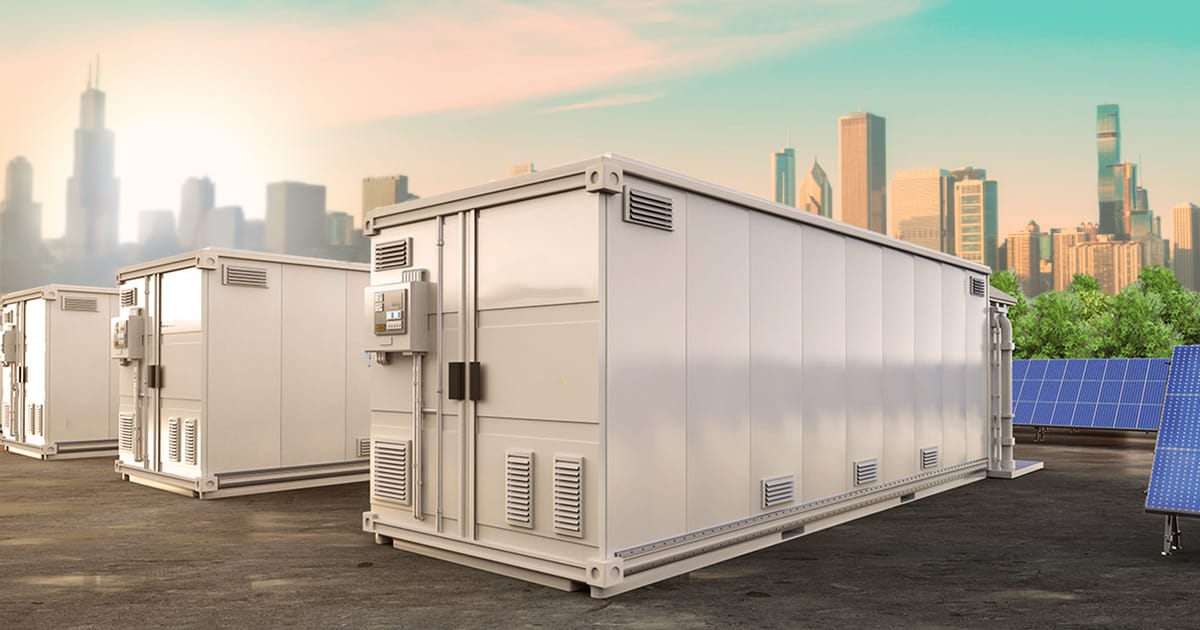
In January, Illinois passed a law that is about to turn thousands of overlooked parcels across the Chicago area into some of the most sought-after real estate in the region’s energy market. Not for buildings — for batteries. The underused lot behind a warehouse, the vacant parcel held for a retail deal that never came, the overflow yard nobody has leased in years: To a fast-growing wave of energy developers, that idle land is exactly what they need, and they are prepared to pay for it on terms most property owners rarely see.
The Clean and Reliable Grid Affordability Act (SB 25) is driving one of the largest battery-storage buildouts Illinois has ever seen — roughly 3 gigawatts of new capacity targeted by 2030. No one needs to follow energy policy to understand what that means for property owners. Batteries have to sit somewhere. And unlike a warehouse or a strip center, a battery project doesn’t need foot traffic, visibility, parking, or an anchor tenant. It needs flat, available land in the right spot near the power grid.
The opportunity can be summed up in one sentence: A new kind of tenant just showed up with a checkbook, and it wants land that most owners weren’t monetizing anyway.
Why this looks familiar
Anyone who has watched Illinois clean-energy policy over the past decade has seen this movie before. The Future Energy Jobs Act in 2016 and the Climate and Equitable Jobs Act in 2021 each triggered a wave of renewable-energy investment — and in both cases, the property owners who moved early captured the most value. They locked in long-term leases at premium rates before the market became saturated, secured the best grid positions before capacity filled up, and got first access to incentives before the caps kicked in.
The pattern is consistent. Lease rates are highest before the market matures. Grid capacity is finite. Every policy cycle rewards the owners who act decisively. Battery storage is simply the next chapter, and the window is open now.
What the deal actually looks like
For the property manager, leasing agent, or real estate investment trust weighing the opportunity, the appeal is that a battery ground lease behaves like a triple-net land lease they already understand. It runs long — commonly 15 to 20 years — with predictable annual payments and built-in escalators. The developer handles construction, interconnection, permitting, and maintenance. The landlord has close to zero obligations, and there’s typically no upfront cost. The owner provides the site; the developer does the rest.
For a property owner or managing director, it’s incremental yield on an asset that was producing nothing. For a leasing agent or broker, it’s a commission on land that wasn’t even in the pipeline. For a REIT or fund, it’s a long-dated, contracted cash flow on a parcel that would otherwise sit idle on the balance sheet.
And the battery-storage footprint is small. A compact grid-scale system can fit on roughly 11,000 square feet — a fraction of what a building requires. Battery storage opens up a far wider range of properties than solar ever did: farmland near a substation, an industrial parcel adjacent to existing infrastructure, even an underused section of a retail parking field.
The zoning advantage most people miss
There’s a quieter reason storage may be the easier deal to get done. Ground-mount solar farms — including community solar — sprawl across acres, and that visibility invites friction: zoning fights, variance hearings, and the familiar not-in-my-backyard resistance that can stall a project for months or kill it outright. A stand-alone battery system is a different animal. It’s stationary, compact, quiet, and low-profile — a cluster of enclosed containers on a small pad rather than a field of panels. That physical footprint tends to move through the local zoning and permitting process with far less drama, which means faster timelines and fewer of the approval headaches that make landlords wary of hosting energy on their property.
What fits on a parcel
For most Chicago-area sites in ComEd utility territory, the practical ceiling is up to 5 megawatts per project. Where a parcel has the right characteristics — or where a landlord holds multiple tax parcels (PINs) or can subdivide — it’s possible to co-locate up to roughly 10 megawatts on a single property, which is where the economics get materially better. A fortunate few with the land and the grid position to support 10-plus megawatts stand to earn well above a typical single-project lease.
The honest caveat: These are ceilings, not guarantees. What a specific parcel can support is heavily dependent on the available capacity of the grid at that location. That’s precisely why a feasibility check comes first — it tells an owner which tier their land is in before anyone signs anything.
How does a site qualify?
Not every parcel works, but the criteria are simple to check:
-
Location relative to the grid. The site needs to sit near existing utility infrastructure with capacity to accept power. This is the single biggest factor, and it can be verified in days.
-
Size. A compact system requires roughly 11,000 square feet at minimum; a larger one needs about an acre.
-
Terrain and access. The site should be relatively flat, with room for equipment placement, an access road, and standard safety setbacks.
-
Zoning. The parcel needs to be zoned appropriately — but because storage is compact and unobtrusive, it generally clears local zoning far more easily than a sprawling solar farm would.
That’s the short list. The location piece is likely to determine a project’s success, and it’s exactly the kind of factor a property owner shouldn’t guess at. A quick feasibility check reveals whether a parcel is likely to interest developers before anyone spends time pursuing it.
The clock is the point
The law has set the stage, and developer demand for qualified sites is already accelerating.As the market picks up, the best grid positions will get claimed, lease rates will normalize, and permitting queues will lengthen. The owners who evaluate their land now — before the market peaks — are the ones who will secure the strongest terms and the fastest timelines.
Under Illinois’ last two major energy laws, the property owners who moved early — before the market matured and the best grid positions were claimed — built lasting income from land they had all but written off. The Clean and Reliable Grid Affordability Act is the next chapter in that story. The parcels are already here. The question is which owners will recognize the opportunity before the window narrows.