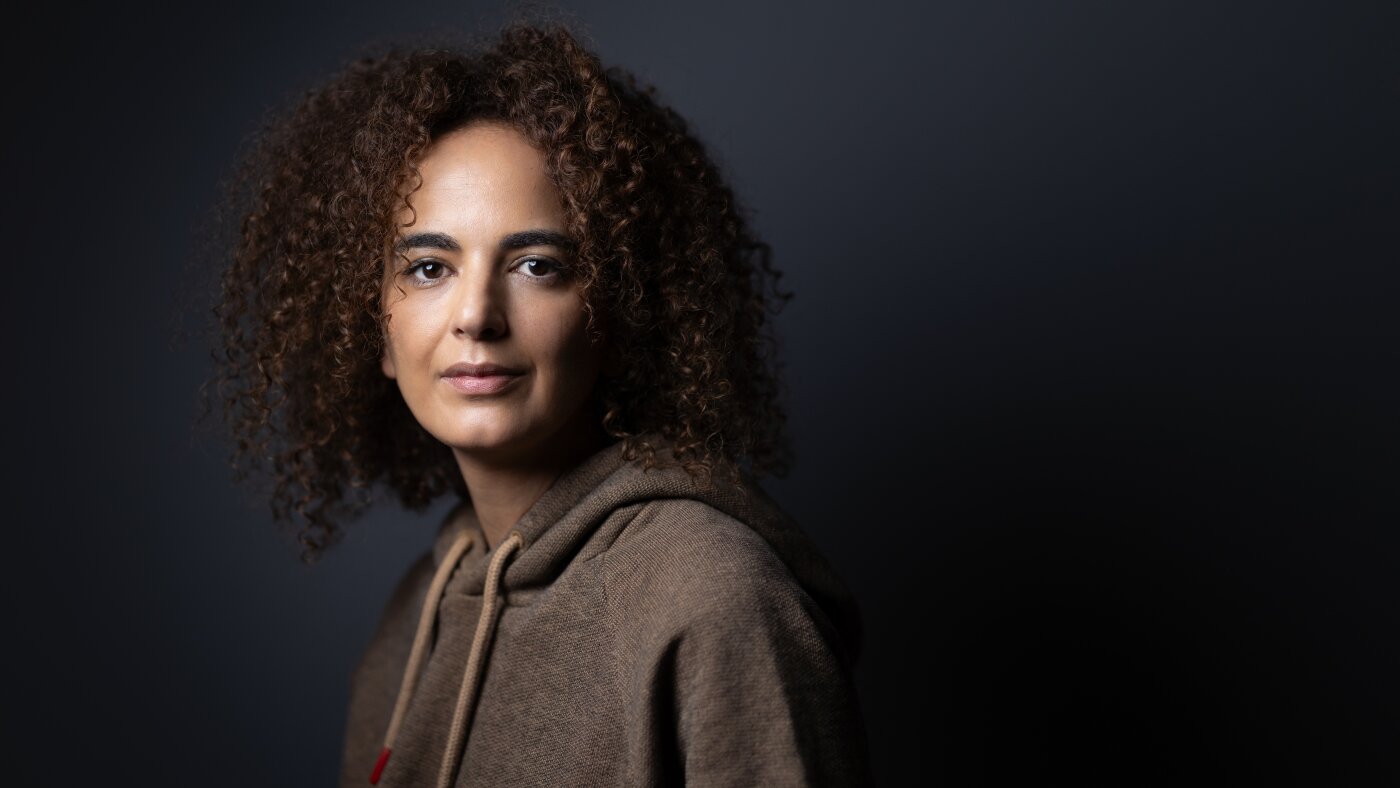
Leïla Slimani’s latest book, I’ll Take the Fire, is the third in a trilogy inspired by generations of her Moroccan French family. She is also the author of the bestselling thriller The Perfect Nanny. She’s pictured above in Paris on March 17, 2026.
Joel Saget/AFP via Getty Images
hide caption
toggle caption
Joel Saget/AFP via Getty Images
As a child in Morocco, novelist Leïla Slimani sometimes felt she lived inside a bubble: There were rules for behavior inside the house, where the family was “very liberal, very free,” and a different set of rules for the outside world.
“[My parents] would always tell us, ‘Outside you have to shut up. Outside you have to be afraid of the Islamists,’ she says. “So you have to hide everything you are. You have to hide everything you think.”
Slimani’s grandmother is French, and her grandfather is Moroccan. She was raised in what she calls a “very complex and multilingual family.”
In Morocco, Slimani observed women being treated as second-class citizens. Both her grandmother and her nanny were illiterate, and her mother pushed her to get an education so that she’d never be financially dependent on a man. When she moved to France for school when she was 18, Slimani expected to experience a new sense of freedom. Instead, she was disheartened by what she found in Paris.
“There were men following you in the subway and in the street at night,” she says. “I was very disappointed [to discover] that my fantasy about the West and my fantasy about this world where women were totally free was a fantasy and was not totally true.”

In 2016, Slimani won France’s top literary prize, the Prix Goncourt, for her novel Chanson Douce (published in English as The Perfect Nanny). Her latest novel, I’ll Take the Fire, is the third in a trilogy of books about a Moroccan French family whose members struggle with their own questions of identity.
“Are they French or Moroccan? Are they Muslim or non-believers?” Slimani says. “We must be very, very wary of all the people who are forcing us to choose a side. I think belonging, of course, can be very comforting. But it can also be dangerous. So this question of belonging, for me, is a very moral question. It’s an ethical question.”
Interview highlights

On being outspoken as a child, and how that led to writing
I always spoke out and my parents were always very, very afraid that something would happen to me. … In a family you have one person sometimes who is a rebel, someone who doesn’t accept the norms, who doesn’t accept the rules. And I was this kind of young girl. And when I was maybe 7 or 8 years old, I had a fight with my father. I did something and he yelled at me and I answered him. And he said, you don’t answer your father. And I said, “It’s my mouth and I say whatever I want.” In French, I said “c’est ma bouche.”
And then it was my nickname for a very long time. My father used to call me “c’est ma bouche,” because I was always speaking out and it was impossible for me to shut up or to be silent when I was feeling something. I had a very strong feeling of injustice and it was something that really destroyed me. And that’s how I think I began to write, because I was always telling my grandmother, “It’s so unfair, it’s unfair.” And one day she said, “Yeah, it is unfair, life is unfair and you will see and you will understand. So maybe write about this and maybe you can resolve or you can try to correct this injustice through writing.”
On her mom’s advice to her

My mother, first of all, she told us at a very young age, because I have two sisters, the first thing that she said and that she repeated years, after years, after years, was that you have to be independent financially, never depend on a man. So you have to study, study, study, and you have to find a job and make your own money and never have as a dream to marry someone who is rich and who is going to take care of you. And the second thing is knowledge. My mother always said the first weapon of a woman is knowledge, the more books you read, the freer you are.
On associating sexuality with fear
For me, I think I had a very dark vision of sexuality. I was always worried. I was incapable of abandoning myself to sexuality because from the moment I became a woman, my mother always told me about sex in a way that she was telling me about danger. The danger of getting pregnant, the danger of going to jail, the danger of being raped. All the dangers. So for me, being a woman was dangerous and I was always afraid. I was always thinking that someone was judging me, that I was not a good woman, that I was not doing the right thing. And I was thinking that for us women it was impossible to be innocent, that from the beginning we were guilty, guilty of something. But I couldn’t understand and I couldn’t know exactly what I was guilty of.
On leaving journalism to pursue fiction writing

What is beautiful about fiction is that you can write about things that you don’t know, and you can write about the things that you didn’t see, that you did not experience. That’s the beauty of imagination. And that’s exactly what you can’t do when you’re a journalist. You’re supposed to say the truth. That’s the goal of your job. And I think that I wanted to write about a different kind of truth, the truth of emotion, the truth of our human condition.
On accepting being selfish in her work
Being a writer makes me selfish because I’m selfish with my time. I’m selfish with space and I think also that it’s not a very likable thing to say, but very often I’m waiting for people to adapt to my schedule and to adapt my vision of things because my goal and my only goal and obsession is writing a novel. And so I consider that my husband, my children, everyone should understand that and that they should all adapt to that. I know it’s very selfish, but it’s how it is. And it would be impossible for me to change that.
Thea Chaloner and Susan Nyakundi produced and edited this interview for broadcast. Bridget Bentz, Molly Seavy-Nesper and Beth Novey adapted it for the web.