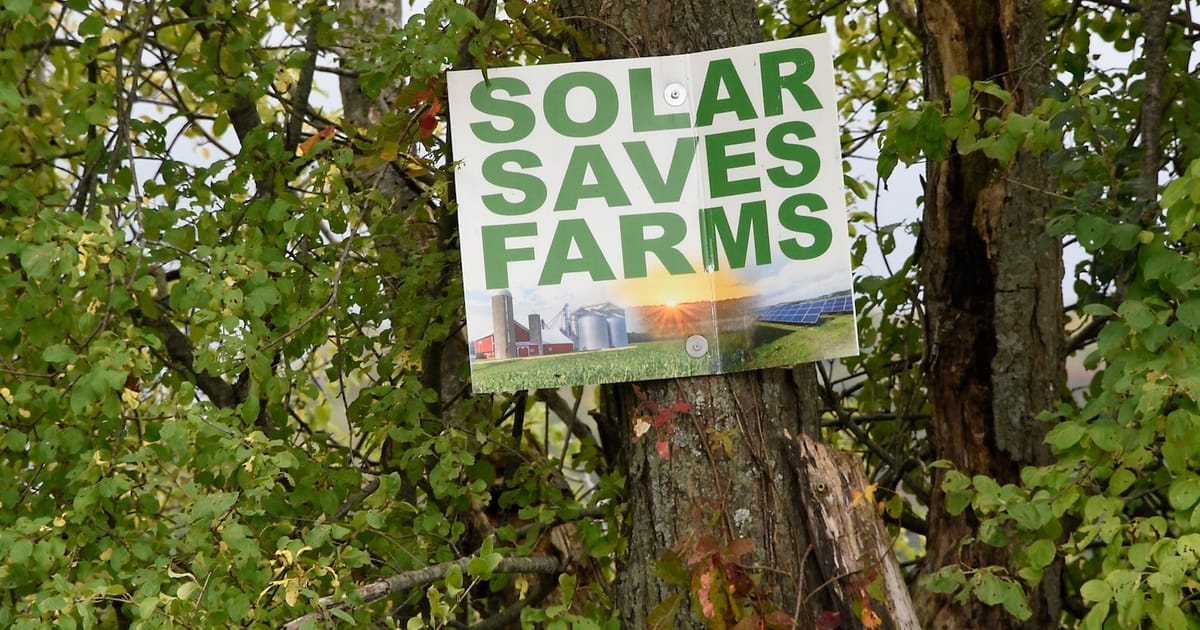
In rural areas across the U.S., solar power opponents keep leaning on the argument that utility-scale arrays are gobbling up valuable farmland. But plenty of evidence proves that’s just not true, and now, New York is tackling the misinformation head-on.
After the Trump administration accused the state of fast-tracking solar farms on prime farmland, New York leaders fired back last week, saying that renewables “empower our farmers to keep their land in use and in their family, while avoiding the threat of permanent conversion or abandonment.” That’s because farmers can lease a plot to solar developers and return it to agricultural use at the end of the array’s life, as the state officials explained in their 11-page letter.
“A recent study by Cornell found that the overwhelming majority of farmers who received solar lease payments used that income to continue or even expand farming on their land, not to exit farming or scale back operations,” the leaders wrote. “Discouraging or inhibiting property owners’ ability to independently make choices about what they can and cannot do with their land can cause financial harm and undermine fundamental property rights.”
The New York State Energy Research and Development Authority has more proof that solar and farming can work hand in hand, and outlined all that in a major guidebook it released last year. Sheep and cattle are munching below panels on several New York farms, the guidebook notes, and the state has zoning rules and protections in place to preserve undeveloped land.
New York’s pushback squares with the findings of a recent report from the Solar Energy Industries Association. That study shows solar farms currently take up a mere 0.13% of New York’s roughly 13,000 square miles of federally designated prime farmland, a stat that resonates across the country. Solar covers just 0.07% of all U.S. farmland, according to SEIA. That’s three times less than golf courses and six times less than suburban development.
And yet solar, not cul-de-sacs, are the focus of a particularly potent campaign from upstate New York influencer Alexandra Fasulo. Fasulo has amassed more than a million followers across TikTok and other social platforms, where she’s constantly posting videos that inflate solar’s threats to agricultural and undeveloped land. Similar sentiments are being spread on social media by John Rich. He’s one half of the “Save a Horse, Ride a Cowboy” guys, and was recently hired by the White House to advocate for landowners on a national scale.
These and other anti-solar advocates often ignore the good that the clean energy source can do for farmers nationwide. In California’s Central Valley, for example, years of drought have led hundreds of thousands of acres of agricultural land to go fallow. Economics and water availability have driven farmers to stop growing there, but they can still make money and hold on to their land by leasing their plots to solar developers.
Plus, as New York’s guidebook points out, farming is still happening alongside solar installations. I recently visited an Illinois solar farm where sheep were grazing underneath and around panels — an arrangement that the sheep’s owners love because they don’t have to maintain expansive pastures back at home. Meanwhile, researchers have found that tomatoes, saffron, and other crops can thrive below panels, and so can native plants.
That’s not to mention the climate benefits of ditching planet-warming fossil fuels, which are driving droughts, floods, and other weather disasters that are legitimately threatening farms in the U.S. and beyond.
More big energy stories
Trump’s coal crusade has real-world consequences
The Trump administration keeps checking items off the coal industry’s wish list — with dire consequences for Americans’ health and wallets.