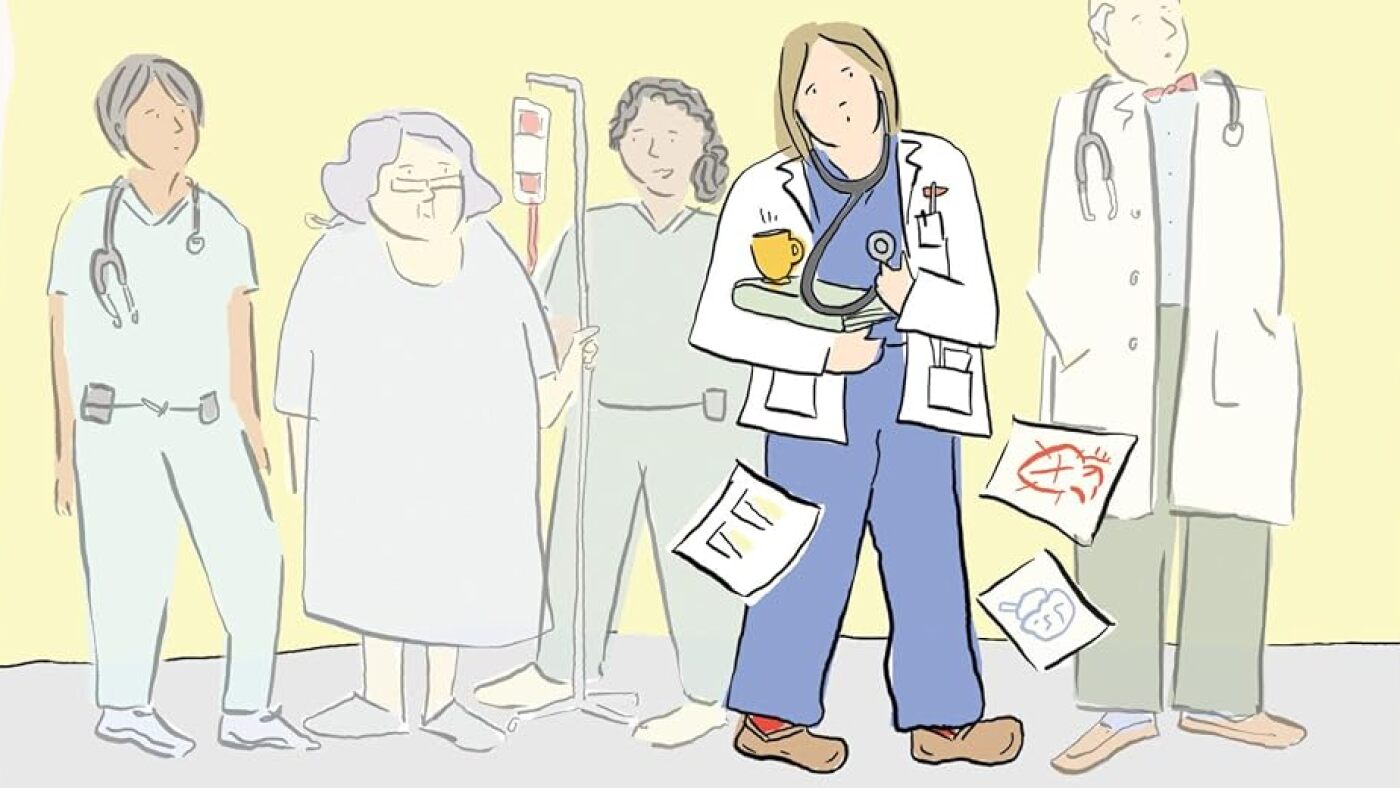
For most people, knowledge of what life on the job is like for healthcare workers comes primarily from two limited vantage points: watching television shows and experiencing their own patient care.
The same is true even for many people who eventually become doctors and nurses, as Grace Farris reminds us early on in her sensitive, energetic graphic memoir, See One, Do One, Teach One: The Art of Becoming a Doctor. “Before I started medical school,” she writes, “I was completely unprepared.” But, as she shows in her new book, once someone has switched over to becoming a professional healthcare worker, a whole new set of issues presents itself. At that point, it can be difficult to toggle from patient to patient –- and to remember what it was even like to be the person receiving care.
From See One, Do One, Teach One: The Art of Becoming a Doctor: A Graphic Memoir by Grace Farris MD
W. W. Norton & Company
hide caption
toggle caption
W. W. Norton & Company
In 2012, not too long after Farris completes her residency, she gives birth to her first child at a hospital in Boston where she works. Her years in medical school and after have already acquainted her with all parts of the birthing process, and her labor does not involve serious complications – but she still experiences a state of shock afterwards. She observes: “Becoming a patient made me want to rethink everything and reconsider my medical training. What had just happened?”

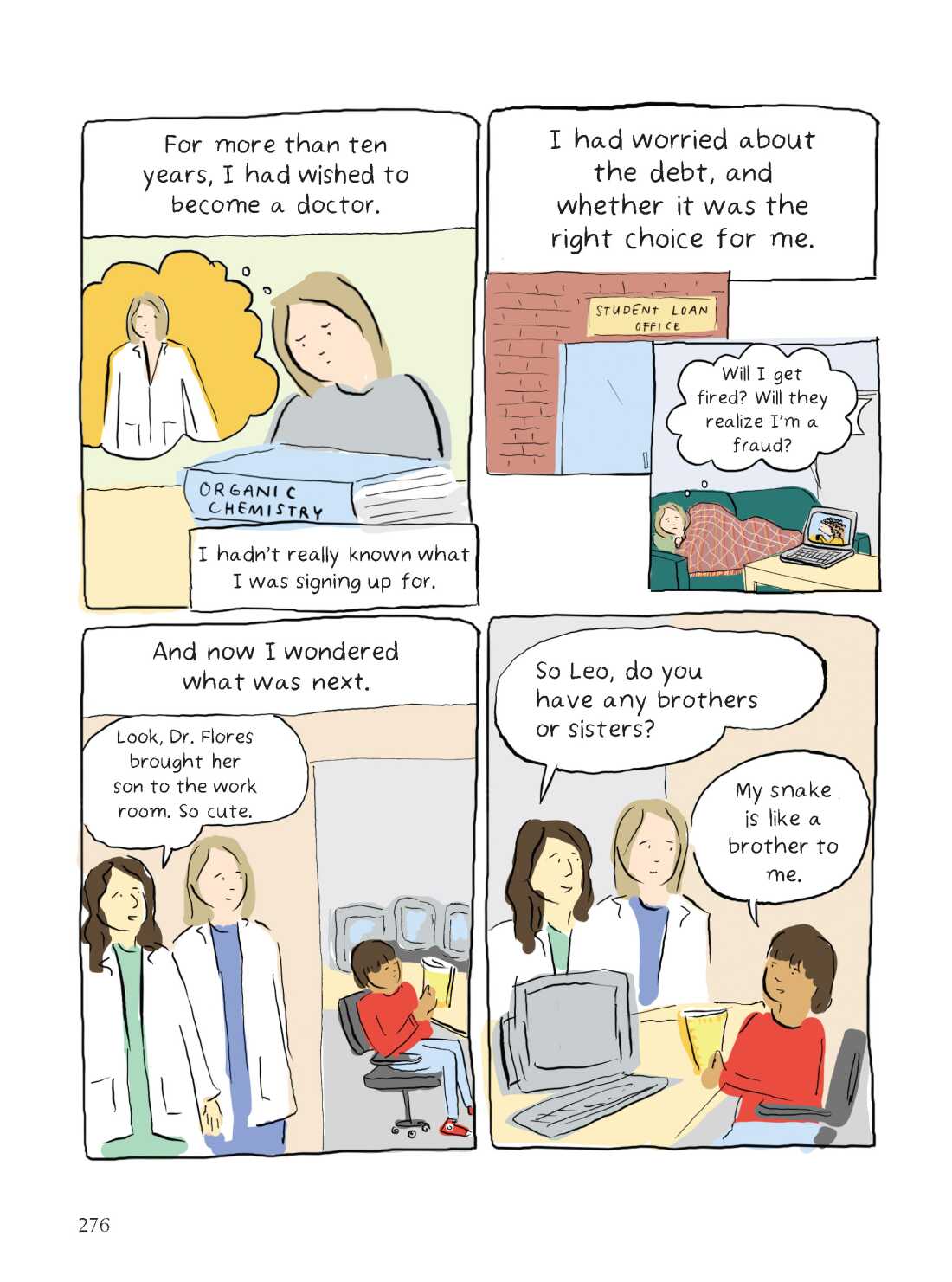
Farris, whose bio gives equal weight to her impressive accomplishments as both doctor and artist, skillfully guides readers on her long and winding medical school journey. While most people recognize that this process takes years and involves various stages, public knowledge of specifics is often oversimplified, overdramatized, or simply left mysterious. Farris brings readers behind the scenes, to help them develop a better understanding of all aspects of the experience — from anxiety over student loans and persistent bouts of impostor syndrome to friendships forged under stressful circumstances and the impossibility of a work-personal life balance. She takes us with her into her first-year anatomy class, where things go along relatively smoothly until, late in the semester, the bone saw is taken out. One of the students goes down, and the professor, without missing a beat, tells the class this is a “typical reaction.” In another scene, Farris describes how medical students end up needing to learn more than 10,000 new words over the course of a year. In a series of illustrated flashcards depicting some of these new words and their meanings (“Necrosis,” “Apoptosis”), we get a sense of just how intricate and overwhelming such an endeavor might feel.
From See One, Do One, Teach One: The Art of Becoming a Doctor: A Graphic Memoir by Grace Farris MD
W. W. Norton & Company
hide caption
toggle caption
W. W. Norton & Company
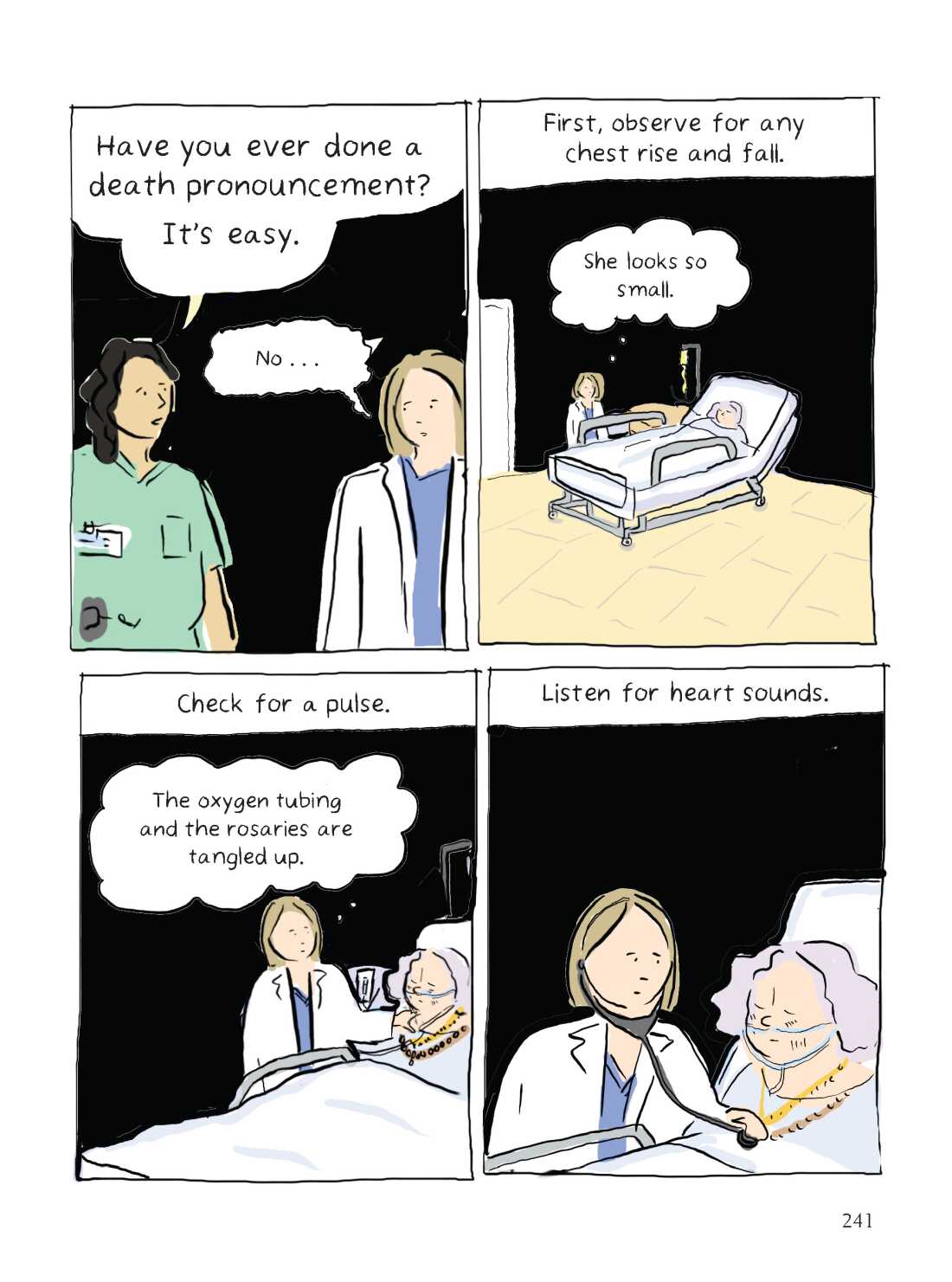
Farris has a knack for breaking down the complexities of the medical school journey to make them accessible and direct, as in a full-page diagram she includes early on, titled, “The Path to Becoming a Doctor.” Here, she maps out the assorted typical stages, from preclinical and clinical years to residency, fellowship, and attending. She plays with visual metaphors, too, throughout, in order to give a sense of the texture of certain feelings and experiences. Working in the emergency room for the first time during her internal medicine clerkship feels like encountering a tsunami, as classroom knowledge and limited clinical experiences are suddenly, and forcefully, put to the test. And later, when she’s doing her medical internship, she suddenly begins to feel less like an impostor, likening the change to the slow, observable transformation of seasons. This reflective occasion is illustrated in a pair of bright images, a landscape of sturdy trees studded with golden leaves.


Farris’ depictions – drawn in a loose, minimal style with a bright, colorful palette – offer generalities that seem relatable for those who have attended med school. They also contain peculiarities specific to her own personal history. Throughout her initial years of med school, even well into her clinical years, she does not know what type of medicine she wants to pursue. We act as witness as she comes to recognize the specializations that are definitely not for her (surgery, pediatrics), and those that could be (psychiatry, internal medicine). For Farris, it’s a slow, anxiety-provoking, and ultimately fulfilling journey to figuring it all out.
Some of the most charming moments in the book occur when Farris recognizes how her artistic interests and her medical pursuits overlap. It’s in dissecting an ear and encountering the tiniest bone in the human body that Farris undergoes a “turning point”: “The tiny stapes was a miracle.” Her artistic skills and sensitivities come into play at various stages of the learning process, like as a way to help her get better acquainted with human anatomy and also when she realizes that it helps to sketch and diagram the various materials that need to be memorized. The title of the book comes from a phrase one of her surgical rotation supervisors passes along, “a classic expression in medicine.” The surgeon asks Farris to watch as the surgical site is sewn up, so she can do this final step of the procedure on her own next time around. “How on earth could I ever teach one?” Farris wonders of the final step in the phrase, after she watches and then attempts the skill on her own.
See One, Do One, Teach One joins a growing body of work often referred to as Graphic Medicine, the community and practice of using comics and illustration to support healthcare workers and patients in their efforts to tell stories that speak to all kinds of experiences. If it’s too easy to forget — or too difficult to envision — what it’s like to be a medical student, healthcare worker, or even a patient in certain situations, books like Farris’ are an effective teaching tool. They offer an important, powerful way to bridge that gap.