Maasai Mara, Kenya – The Maasai Mara, Kenya’s most famous wildlife reserve, is one of Africa’s best-known safari destinations. Every year, hundreds of thousands of visitors travel to the reserve, generating millions of dollars for Kenya’s economy and supporting jobs, businesses and local communities.
But as luxury camps and lodges spread across the reserve, concerns are growing over the environmental cost of tourism. Conservationists warn that unchecked development is damaging wildlife habitats and threatening one of the world’s greatest natural spectacles, the annual migration of wildebeest, zebras and gazelles between Tanzania’s Serengeti National Park and Kenya’s Maasai Mara National Reserve.
The debate has now reached Kenya’s courts.
A legal battle over the Mara
The future of the Maasai Mara is increasingly being contested in court. Conservation groups have filed several cases challenging the construction and expansion of tourist camps inside and around the reserve, arguing that some developments were approved without adequate environmental safeguards.
The latest petition, filed by the East Africa Law Society, Natural Justice, JustAct and the Africa Centre for Peace and Human Rights, seeks conservatory orders to halt the construction and expansion of accommodation facilities in the Maasai Mara National Reserve pending the hearing of the case.
The petition names the Ritz-Carlton Hotel Company, Marriott International, Lazizi Mara Limited, the Narok County government, the National Environment Management Authority (NEMA), the attorney general, the Kenya Wildlife Service (KWS), The Safari Collection Ltd and Minor Hotels Ltd.
Court documents filed by advocate Gichohi Waweru challenge the construction and operation of the Ritz-Carlton Maasai Mara Safari Camp, alleging that it was built in a protected ecological zone despite a 2023 moratorium on new tourism accommodation in sensitive areas of the reserve under the Maasai Mara Management Plan 2023-32.
The petition also claims that the camp lacks a valid environmental impact assessment licence and sits along a key wildebeest migration corridor.
The petitioners are seeking an audit of all lodges in protected zones, warning that continued development could cause irreversible damage to the Mara ecosystem.
The legal battle has become a test of whether Kenya can balance conservation with tourism, one of the country’s most important economic sectors.
Kelvin Kubai, an advocate at the High Court of Kenya, told Al Jazeera that tourism should never come at the expense of wildlife and the environment.
“When the interests of wildlife and nature conflict with tourism, the rights of nature are supreme. Any interaction between tourists, wild animals and the environment should not come at the expense of the animals. The rights of human beings in the Mara are not above those of animals and nature,” he said.
The disappearing migration
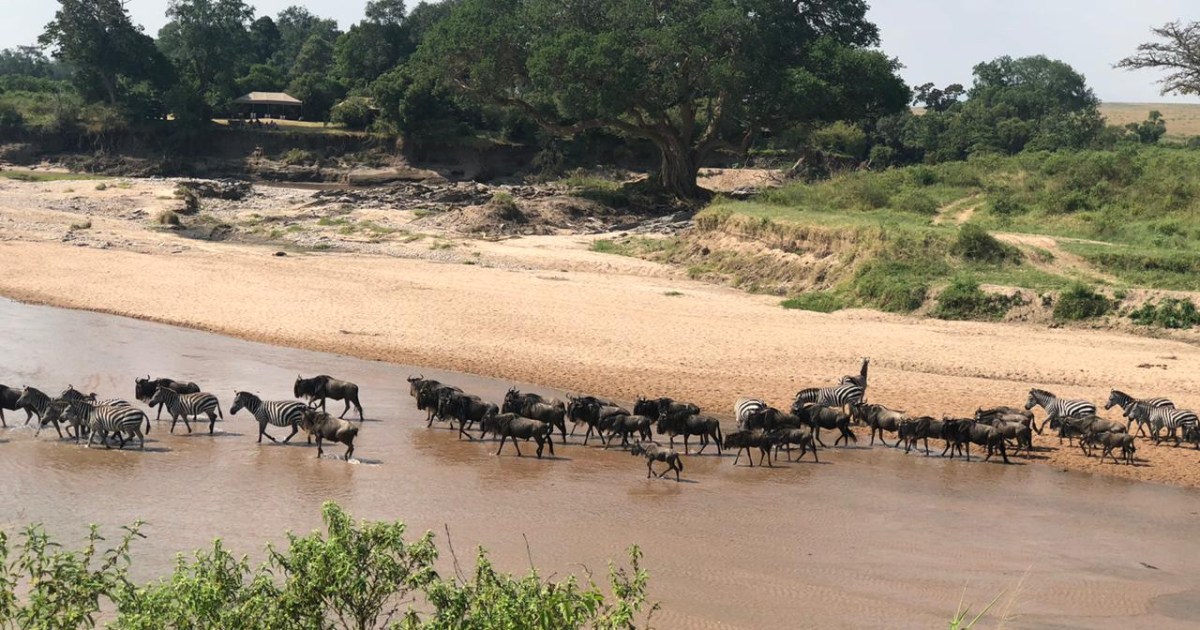
Every year, more than a million wildebeest, zebras and gazelles move between the Serengeti and the Maasai Mara in search of fresh grazing land. The migration sustains predators, attracts visitors from around the world and plays a crucial role in maintaining the health of the ecosystem.
Kenya has, however, seen a significant decline in the number of wildebeest making the journey into the Maasai Mara. Conservationists say that construction, vehicle traffic and human activity near migration routes are disrupting animal movements and placing additional pressure on wildlife already affected by climate change.
According to a Kenyan government wildlife survey whose findings were released after fieldwork conducted between June 2024 and August 2025, populations of several species, including lions, buffalo, hirola antelope and wildebeest, have fallen sharply. Wildebeest numbers declined from 58,000 to 34,200 between 2023 and 2025.
Scientific data released in early 2026 showed that the number of wildebeest using one of the key migration routes in the Greater Mara ecosystem had fallen by almost 90 percent in just five years.
The pressure from tourism development has become a central concern. Despite the 2023 moratorium on new tourism accommodation in sensitive parts of the reserve, conservationists say new camps have continued to emerge while existing facilities have sought to expand.
The moratorium was introduced to curb overdevelopment, reduce pressure on wildlife habitats and protect migration corridors, but conservationists argue that enforcement has been weak.
Samwel Odhiambo, a climate activist and founder of the Climate Awareness Defenders community-based organisation, told Al Jazeera that conservation must take precedence over commercial interests.
“The government must rein in investors who do not really care about conservation because everyone has a responsibility to the environment and the animals. What we are seeing today is a result of developments that are profit-driven, to the point where lodges are built on riverbanks, too close to animals, and on migration routes, affecting especially female animals as they lose their habitats for nurturing and delivering their babies.”
Odhiambo argued that the same level of environmental protection applied along Kenya’s coast should be extended to the Mara.
“Kenya’s coast at times generates more tourism revenue than the Maasai Mara, but you will not find developers building on the beach or in the waters,” he said.
Maps published in December 2025 by ecologists at the Smithsonian National Zoo and Conservation Biology Institute in the Atlas of Ungulate Migration showed that migration routes supporting more than 100,000 wildebeest as recently as 2020 now support fewer than 30,000.
The report estimated that the wildebeest population, which numbered between 120,000 and 150,000 in the 1970s, had fallen to about 26,700 by 2024. Settlement and fencing across the Loita Plains and northern Mara Plains have severely restricted migration, confining surviving herds to a patchwork of conservancies surrounding the reserve.
Although these figures come from different wildlife surveys and migration studies, they all point to a sharp decline in wildebeest numbers and movements across the Greater Mara ecosystem.
When tourism threatens itself
For decades, the Maasai Mara has been Kenya’s premier tourism destination, earning billions of shillings annually and supporting thousands of jobs, from safari guides and hotel workers to transport operators, craft sellers and Maasai communities.
But conservationists and tourism analysts warn that overdevelopment could begin undermining the very industry that depends on the reserve’s wildlife and wilderness.
![The Maasai Mara’s vast grasslands have made it one of Africa’s most iconic wildlife destinations, but conservationists say its future depends on balancing tourism with protection of nature [File: Evelyn Kahungu/Al Jazeera]](https://www.aljazeera.com/wp-content/uploads/2020/08/fa407935083f412685011c79e90cbbb7_6.jpeg?w=770&resize=770%2C433&quality=80)
Tourism operators say overcrowding, rising park fees and increasing competition from other regional destinations have made the safari market more competitive. Conservation groups argue that continued habitat loss and pressure on wildlife corridors could further erode the Mara’s appeal to visitors seeking intact wilderness and abundant wildlife.
Al Jazeera contacted Marriott International, Lazizi Mara Limited, the Narok County Government, NEMA and KWS for comment. Marriott and Lazizi have previously said the Ritz-Carlton Maasai Mara Safari Camp received the necessary approvals and complied with Kenyan environmental and planning requirements, while Kenyan authorities have defended the project as being located in a designated tourism investment zone under the Maasai Mara Management Plan 2023-32.
Wangari Kebuchi, an economist and managing director of Expertise Global, told Al Jazeera that the conservancy model offered the most viable path forward, provided it was accompanied by stronger oversight.
“The Maasai Mara is one of Kenya’s biggest economic assets and a major source of foreign exchange, but Narok County depends too heavily on it for revenue. If wildlife numbers decline because of overdevelopment, tourism demand will eventually fall. The conservancy model will help by protecting wildlife corridors and limiting visitor numbers, but it needs stronger oversight. Future tourism growth should be guided by ecological limits, not commercial demand, so the Mara remains both environmentally healthy and economically sustainable,” Kebuchi said.
For conservationists, the court cases are about far more than a single luxury camp. They could determine whether Kenya is willing to enforce ecological limits in one of Africa’s most celebrated landscapes.
As the legal battle unfolds, the question is whether the Maasai Mara can remain both a thriving wildlife ecosystem and a sustainable source of livelihoods and tourism revenue.
“Future tourism growth should be guided by ecological limits, not commercial demand, so the Mara remains both environmentally healthy and economically sustainable,” Kebuchi said.