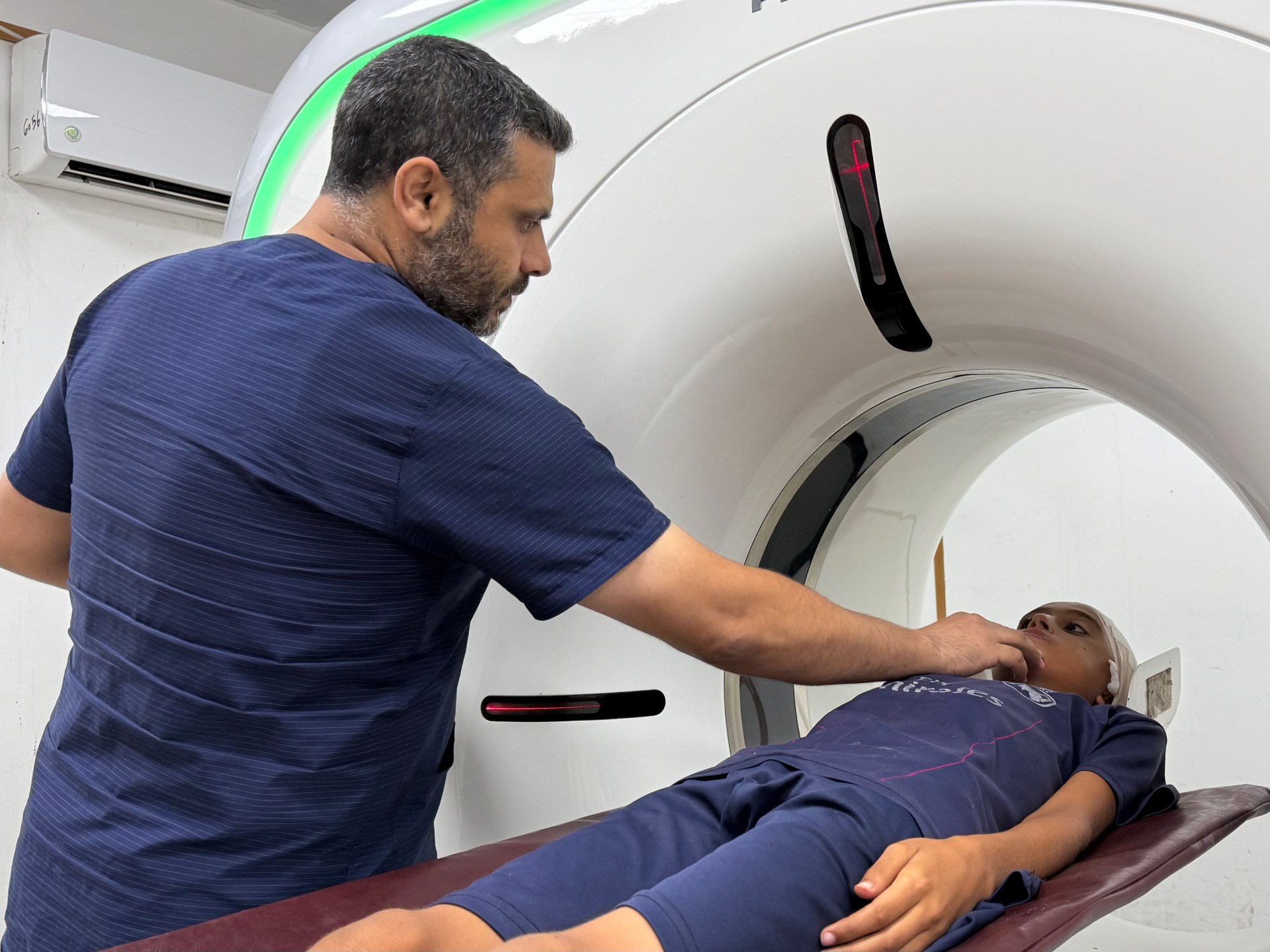
Dalia Al-Hawari stood behind the glass partition in the hospital imaging room, watching in silence as her 10-year-old son prepared to have a CT scan to determine the extent of his injuries.
Ahmed was playing with friends when he slipped and fell, hurting his head. The scan results showed a fracture to his skull and severe bleeding, with doctors saying there needed to be emergency medical intervention to deal with his injuries.
Recommended Stories
list of 4 itemsend of list
“This was an emergency case. We could not wait. We were referred from Al-Aqsa Hospital to Yafa Hospital to undergo the CT scan because Ahmed needed a rapid diagnosis,” Dalia added.
“[Initially] I was very scared because I know that getting a CT scan in Gaza can take weeks, and sometimes one or two months, due to the overwhelming pressure and the shortage of available machines.”
Ahmed’s speedy assessment meant he was fortunate. But his mother’s initial concerns reflected those faced by thousands of patients in Gaza, where access to advanced diagnostic imaging has become a dreaded waiting game. Delays in diagnosis can seriously impact people’s lives and even result in death.
It follows extensive damage to Gaza’s health infrastructure and shortages of medical equipment due to Israel’s ongoing genocide.
According to the World Health Organization (WHO), 94% of hospitals in Gaza have been damaged or destroyed, resulting in only 19 out of 36 of the facilities partially functioning as of May 2025.
Israel’s ongoing siege on Gaza is further limiting health services for Palestinians in Gaza.
Dr. Waseem Mansour, a physician at Yafa Hospital in central Gaza, says the crisis in the medical imaging department is one of the most serious consequences of the collapse of the healthcare system, reducing the ability of doctors to accurately diagnose conditions and make appropriate treatment decisions.
Mansour says the number of CT scan machines available in Gaza has declined significantly since the war on Gaza started on October 8, 2023.
“Gaza had 18 CT scan machines before the war, but today only three main machines are operational to serve all governorates of the Strip,” he said. “All seven MRI machines that were available before the war are now out of service.”
That puts enormous pressure on the few existing machines that remain operational, especially after the CT scanner at Al-Aqsa Hospital stopped functioning, forcing other centres, including Yafa Hospital, to receive a larger number of cases from blast wounds to heart attacks.
“We are forced to apply strict rationing of examinations, giving priority only to life-threatening cases, while less urgent cases have to wait,” he said.
“Delays in performing imaging do not simply mean delays in diagnosis; they can lead to serious complications, especially for cancer patients who need early detection and follow-up before the disease progresses.”
Medical teams are forced to use X-rays and ultrasound to deal with the backlog, but these do not always provide the needed information available from CT scans or MRI.
“The absence of advanced diagnostic tools places doctors in a major challenge when making the appropriate medical decisions,” he added.
Thirty-one-year-old Erin Al-Banna has been waiting around six weeks for medical imaging after suffering from kidney stones that caused severe, recurring pain.
Her hopes are dashed every time she hears that other cases have a higher priority and she is still waiting for a treatment date.
“I have been waiting for my turn for a month and a half. Every day I suffer from severe cramps, and I rely on painkillers just to tolerate the pain. But I do not know how long I will remain in this situation,” she said.
“We are living in extremely difficult conditions. The water we drink is not the same as before, and most of the available food is canned because of the circumstances of the war. I feel that these conditions have affected my health, but I cannot even undergo the examination to know the real reason behind my continued pain.”
While priority is given to life-threatening cases due to the limited availability of imaging services, patients such as Erin remain on long waiting lists, turning their daily pain into a prolonged struggle linked to delayed diagnosis and medical care.
As medical imaging services continue to deteriorate, patients face a long journey of waiting and uncertainty, while doctors attempt to make treatment decisions with limited tools. The stories of Ahmed and Erin reflect only part of the suffering for thousands of patients who need timely and accurate diagnoses but face delays that could cost them their lives.