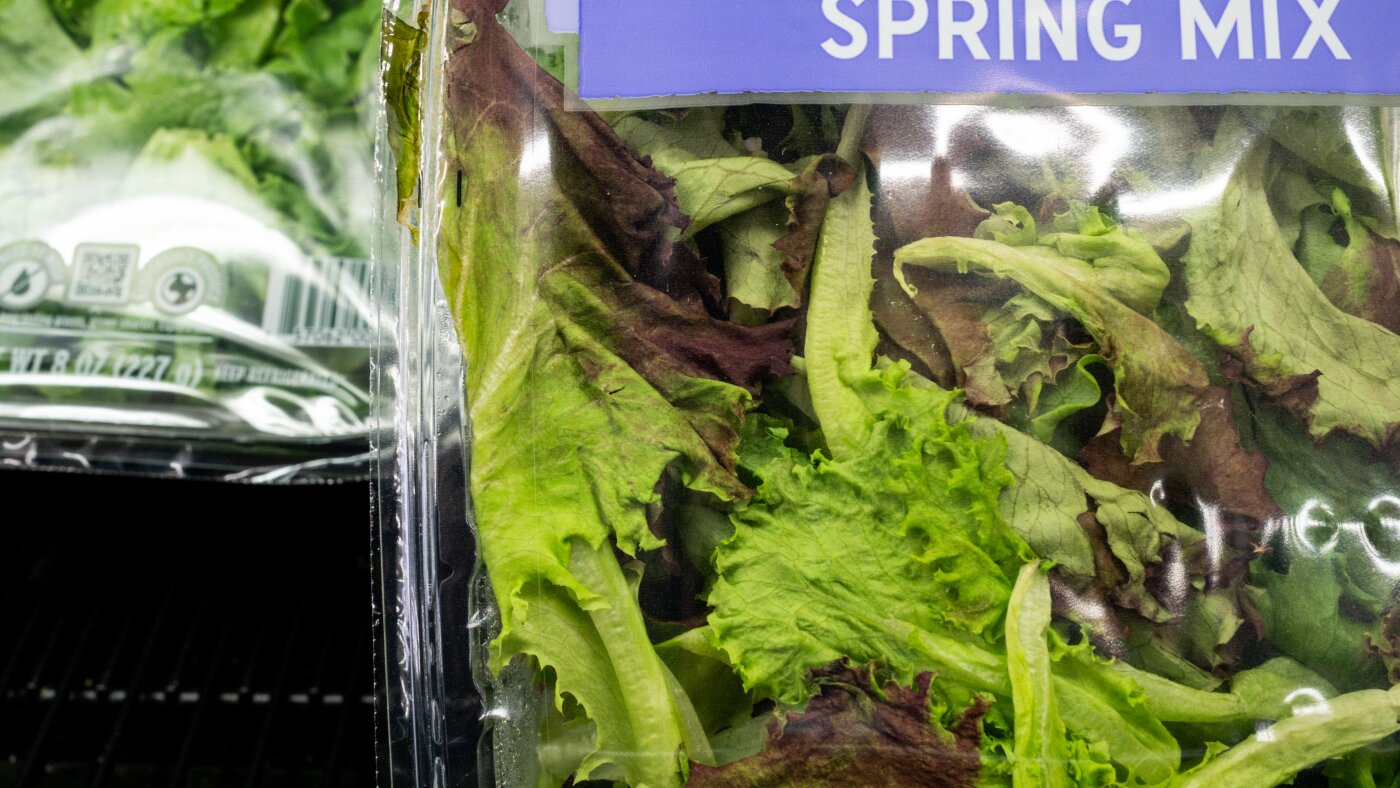
Spinach is displayed for sale on shelves at a Target store on July 23, 2026 in Austin, Texas.
Brandon Bell/Getty Images
hide caption
toggle caption
Brandon Bell/Getty Images
Cyclospora and Christopher Nolan’s nearly three hour adaptation of The Odyssey have something in common — parasites.
For Cyclospora, that connection is easy to make. The microscopic parasite causes cyclosporiasis, the intestinal illness that has sickened thousands of Americans.
And while Odysseus does not face an intestinal parasite on his long journey home — though his voyage was still quite miserable — he encountered another kind when he returned to Ithaca. Those were the suitors who had taken over his home, courting his wife Penelope. They embodied a popular character trope in ancient Greek writing: one that originated as a form of comic relief.
As part of NPR’s “Word of the Week” series, we’re explaining how the word “parasite” started as a joke and became anything but funny.
A witty dinner guest in ancient Greece
The original definition of parasite or “parasitos” comes from Greek, literally translating to “alongside of (para) grain or wheat (sitos).”
The ancient Greeks used the word to describe someone, usually poor, who would entertain a wealthy person for food. The sentiment became an “institution” in ancient Greece and Rome, said Richard Martin, a classics professor at Stanford University. It turned into a comedic stock character, he said.
“You should always expect the parasite to come on stage and do crazy stuff,” Martin said.
The parasite is a jokester figure who tries to derail the main character and cause confusion, with comedic names like “Bread-Chewer,” Martin said. The character could also lean towards the “sleazy” side. The character was big in “New Comedy,” he said, a “kind of domestic sitcom style” humor that started in fourth century B.C., specifically from the Greek playwright, Menander.
For a modern example, Martin points to the comedy duo Abbott and Costello from the 1940s and ’50s. They’re known for the classic “Who’s on First” comedy sketch.
Craig Jendza, an associate professor of Ancient Greek and Roman Studies at Denison University, said that to audiences, the humor of the parasite laid in their uncanny ability to do anything they possibly could for food. Take, for example, plucking dandruff off another person’s head, he said.

In The Odyssey, the freeloading suitors in Odysseus’ home are also considered parasites — without the “comedic overtones,” Jendza said. That’s also implicit in the repetition of breaking “Zeus’ law” that’s often cited in the Nolan movie. “That’s what’s going on with the parasite,” Jendza said. “He’s exploiting those social obligations… and he’s doing it for his own self-interest.”
In that sense, Martin said, The Odyssey was ahead of his time: “[The suitors] are parasites in the modern sense: They give nothing, but they take everything.”
A biological threat
Today, most people know of a parasite as a tiny organism, one that needs a host to live. “A parasite is something that is preying on something else,” Craig Hedberg, a professor in the School of Public Health at the University of Minnesota.
There’s a plausible linguistic pathway from ancient Greece, said Brian Joseph, a distinguished university professor emeritus of linguistics at The Ohio State University, since they also saw the parasite character as a “freeloader.”
Martin, the Stanford professor, said doctors up until at least the 20th century understood Greek and Latin — so he can see how the ancient definition could come to describe “the kind of bug that feeds off another one.” This new definition just loses the humor.
“Bring back the funny parasite,” Martin said.
That brings us to the microscopic gastrointestinal parasite that’s wreaking havoc right now: Cyclospora, which has caused outbreaks in at least nine states. It infects the small intestine and causes excessive diarrhea, fatigue and cramping for several weeks, said Gerardo Lopez, an associate professor of food safety and environmental microbiology at the University of Arizona.
Like the Greek parasites, Cyclospora does like to eat: “They are gaining nutrients from us,” Lopez said. And their ability to attach to foods like iceberg lettuce and live inside humans is “brilliant,” he said.
But unlike the literary figures, “there’s nothing funny about it,” Lopez said. Hedberg, the University of Minnesota professor, agrees.
“We have a lot of fun talking about diarrhea, but diarrhea isn’t a fun thing to actually experience on a personal level,” Hedberg said.