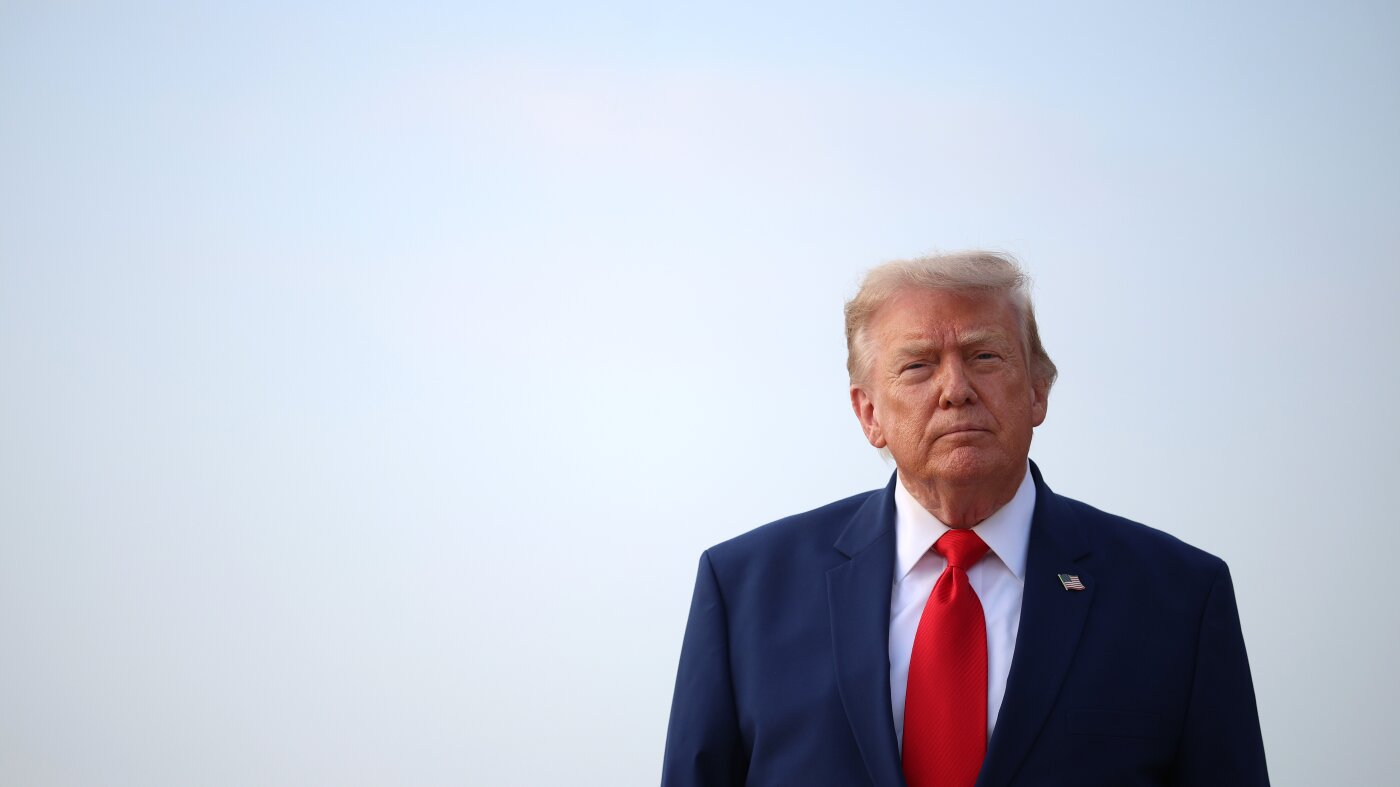
U.S. President Donald Trump looks to reporters after getting off Air Force One on July 22, 2026 at Joint Base Andrews, Maryland.
Kevin Dietsch/Getty Images
hide caption
toggle caption
Kevin Dietsch/Getty Images
On the day the Supreme Court ruled against a broad swath of President Trump’s tariffs, he was visibly angry – and determined to enact more tariffs anyway.
“Other alternatives will now be used to replace the ones that the court incorrectly rejected,” he said at a White House press briefing on February 20. “We have alternatives, great alternatives.”
“Alternatives” referred to laws the administration might use to authorize tariffs, after the Supreme Court said tariffs under the president’s preferred route – a 1977 law called the International Emergency Economic Powers Act, or IEEPA – were unlawful.
Since then, the administration has demonstrated its willingness to implement a variety of those laws to rebuild the president’s tariff regime. This week brought a flurry of evidence of that, as the administration replaced a global tariff with a set of new tariffs, levied new fees on Canadian imports, and threatened future tariffs on pharmaceuticals. It’s an indication that the president remains defiantly committed to a favorite economic policy, even while Americans have grown frustrated with the taxes on imports.
Overnight, at 12:01 AM Eastern Friday, a global 10 percent tariff the president instituted after the Supreme Court’s decision, expired. Those replaced a global tariff instituted under a law allowing a president to impose temporary tariffs to address particular economic problems.
The administration timed a new set of tariffs on all of its largest trading partners to take effect at the same time the old, global tariff ended.
The new tariffs have two tiers, of 10 and 12.5 percent, imposed on goods from the U.S.’s 60 biggest trading partners – 59 countries, plus the European Union. Those tariffs were instituted under a law allowing tariffs to address unfair trade practices by foreign countries. The administration said these new tariffs are because those countries are importing goods made with forced labor.
Though the new tariffs aren’t on goods from every country, they are nevertheless sweeping — the U.S. Trade Representative’s office has said the countries whose goods are tariffed are responsible for more than 99% of imports to the US.
However, some big categories of imports, such as energy and many categories of foods, will be exempted.
The timing was intentional, a senior administration official not authorized to speak on the record, told reporters on Thursday. They said the administration made the changeover “to avoid complexity” for businesses paying the tariffs. However, they also contended that the administration cares deeply about ending forced labor.
In fact, the administration was sweeping in condemning the rest of the world – including its strongest allies and largest trading partners – on this topic.
“The United States is the only country in the world to adopt, and effectively enforce, a ban on imports made with forced labor,” read a US Trade Representative fact sheet on the new tariffs.
Some critics of the tariff policy do not buy that this is a good-faith effort at improving labor practices. At a hearing this week where US Trade Ambassador Jamieson Greer testified, Sen. Ron Wyden, D-Oregon, accused the administration of lying about its motivations.
“Donald Trump dug up a zombie law to make things even more expensive for Americans,” Wyden said. “Trump’s next trade scheme is ordering USTR to reconstruct his illegal global tariffs under the guise of addressing forced labor,” he said referring to the office of the United States Trade Representative.
Alternative methods
While IEEPA gave the president the ability to impose tariffs unilaterally and quickly, some of these other avenues require a much slower process. These new forced-labor tariffs are the result of a months-long investigation. Similarly, the president’s tariffs on a variety of specific goods, such as aluminum, lumber, and semiconductors require investigations as well.
That said, Trump showed this week that he can still act quickly in some cases – as when he signed proclamations imposing new 50% tariffs on some Canadian goods, starting just under a month from now. To impose those tariffs, he invoked a 1930 law that has never been used for tariffs before.
While the president is using new legal justifications, it doesn’t mean his other instincts around tariffs have changed. For example, Trump has many times threatened tariffs that were never instituted. It’s possible, in the case of the Canada tariffs, that the two countries will negotiate some or all of them away as they renegotiate the USMCA, the free trade agreement covering the US, Mexico, and Canada.
Similarly, the president in March threatened to cut off all trade with Spain, over its unwillingness to let the U.S. use its military bases in the U.S.-Israel-initiated war in Iran – a threat he repeated earlier this month.
And the pharmaceutical tariffs the president floated this week would not go into effect for two years – plenty of time for circumstances (or the president’s mind, or both) to change.
All of these tariffs are being instituted using a variety of different statutes, known by three-digit numbers – 122, 338, 232, 301 – for the sections of laws being invoked. And this growing patchwork of tariffs on specific countries and products may mean an increasingly complicated scheme for importers to follow.
“It has created a much more complex landscape with all of the three-digits going at once and having to figure out: do they add, how does one fit with the other, what are the exceptions?” said Kathleen Claussen, a professor at Georgetown Law School who specializes in trade law. “It is a far more complex landscape, I think, than it was a year ago.”
More to come?
And still more could be coming — there’s a current section-301 investigation into more than a dozen countries and the EU. The administration says those countries are being unfair in their manufacturing — for example, by overproducing.
While Trump rolls out the new import taxes, poll after poll shows Americans don’t like the tariffs, and that their approval of the president on the economy has declined.
But regardless of the politics, the president is fond of tariffs – he regularly calls tariff his favorite word in stump speeches. Indeed, the president’s criticism of free trade deals such as NAFTA and willingness to entertain protectionist policies instead, was part of the populist pitch that initially got him elected in 2016.
Since then, he has shown that he likes the policy in part because it helps him strong-arm other countries into giving concessions on trade deals.
And his administration maintains that the tariffs will have long-term economic benefits – primarily, boosting manufacturing.
“The problems the president’s trade policy seeks to solve are generational,” Greer told senators this week. “These things were not broken in the day, and they won’t be fixed overnight. But they must be fixed.”
The manufacturing employment boom has not come yet – employment in the sector remains below where it was when Trump took office.
That means committing to tariffs is a gamble, as Trump asks voters to weigh a policy they may dislike against what might happen in the future.