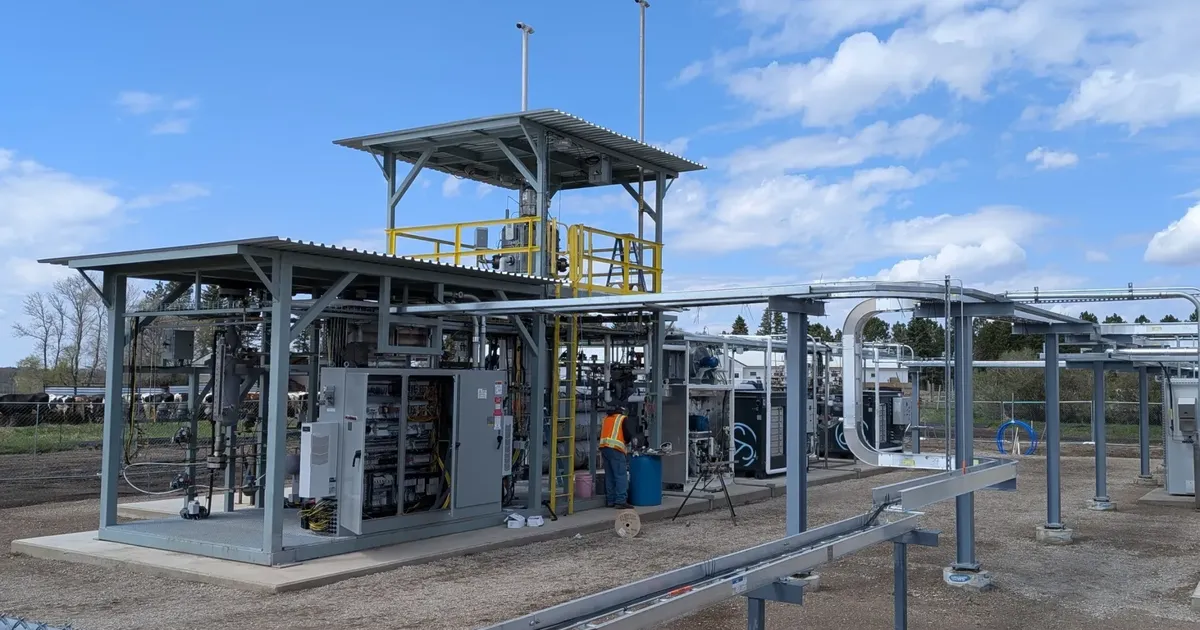
In the shadow of a wind turbine on a low rise just outside the western Minnesota town of Morris, a cluster of tanks, pipes, and sheds holds what some believe is the key to a more self-sufficient future for the region’s agriculture and heavy industry.
When the wind is blowing — and it often is, out here — the turbine powers two electrolyzers that cleave hydrogen from water, another system that separates nitrogen out of the air, and a third that binds the two elements to form anhydrous ammonia, a critical input for corn farming. The University of Minnesota West Central Research and Outreach Center commissioned the plant earlier this spring and can produce hundreds of kilograms of homegrown ammonia daily.
As a stable, efficient carrier of hydrogen, the homegrown ammonia could eventually supply raw material for other types of fertilizers, transportation fuels, and high-temperature industrial processes like ironmaking.
“It’s about 100 times cheaper to store and transport ammonia than hydrogen … so this is a gateway for other hydrogen-based industries,” Michael Reese, green ammonia research lead at WCROC, said on a tour of the facility this spring.
“Gateway” is the operative word here. Reese said WCROC plans to add a third electrolyzer to the project in a “future phase,” bringing daily production capacity to about 1 metric ton and annual production between 300 and 400 tons. That sounds impressive, but it’s a rounding error in a highly consolidated industry that produces around 250 million tons of ammonia annually. Minnesota alone imports up to 900,000 tons per year.
That’s a minimum $500 million annual transfer from Minnesota farmers to out-of-state fertilizer suppliers, most of which synthesize the stuff from cheap natural gas at sprawling facilities on the U.S. Gulf Coast, Brandon Isakson, managing director for industry with the St. Paul–based environmental nonprofit Fresh Energy, said in an interview. When prices are high, as they are this year, the outlay can exceed $1 billion, he said.
Anhydrous ammonia and its chemical cousin, ammonium (NH4), join nitrate (NO3) and urea (CO(NH2)2) as the three main nitrogen-derived fertilizers used in modern agriculture — often in combination. All three, along with nonnitrogenous fertilizers like potash and phosphate, are produced in massive “world-scale” plants that put out hundreds to thousands of metric tons daily. They depend on complex global supply chains to reach end users.
Right now, those supply chains are under intense pressure due to the U.S.-Israeli conflict with Iran. About one-third of the world’s urea and one-fifth of its ammonia pass through the Strait of Hormuz, which has been effectively closed to cargo traffic since the beginning of March. While the U.S. has plenty of domestic production capacity, U.S. Department of Agriculture data shows it still imported nearly 40 million tons of various fertilizers in 2025, including nearly 8 million tons of solid and blended urea. Prices for imported urea spiked when the shooting started earlier this year, underscoring domestic farmers’ tenuous relationship with global commodities markets.
Though WCROC has plans to grow the Morris facility, production likely won’t expand there in time to matter for the Hormuz crisis. Nor would it reach the kind of scale that could make a meaningful difference for Minnesota farmers, let alone other hydrogen-hungry industries.
“You’d like to be at 50,000 tons per year to be cost-effective,” Reese said.
But Reese added that he’s optimistic about a not-too-distant future where scaled-up ammonia production facilities dot the Minnesota countryside.
So are others involved with the project. Sameer Parvathikar, senior director of sustainable energy solutions at RTI International, an independent research institute that collaborated with WCROC, said at an April event celebrating the Morris system’s commissioning that it was an important milestone in a multiyear effort to stand up a new, cost-competitive industry from scratch.
“For those of us trying to push this forward from a technology perspective, you realize we have done stuff that actually matters,” he said, noting turnout that included higher-ups in the University of Minnesota system and a North Carolina–based developer looking at commercial applications for an ammonia production pathway that uses clean electricity instead of fossil gas.
At least some farmers here and elsewhere across the Corn Belt see the potential in local ammonia production, too.
Fertilizer prices, policy spur investment in modular green ammonia plants
In March, a southern Minnesota farming cooperative said it would partner with a Texas-based infrastructure company, a Minneapolis-based carbon credits registry, and the local power and water utility on a project that could produce most of the ammonia its farmers need within a few years. Located in Blue Earth County, the modular plants could pump out as much as 12,000 tons of ammonia annually, the companies said.
It would be one of the first larger-scale deployments of a “modular, green ammonia system that makes the local production and distribution of a critical raw material cost-competitive and more reliable,” according to Talusag, the company behind the technology.
Talusag says its approach lowers ammonia costs by up to 50% by freeing production from fragile global supply chains and using no raw materials other than abundant sun, air, and water. In theory, its plants can locate anywhere with an adequate power supply, whether that’s the middle of farm country or a remote mine site.
KC Graner, president and CEO of Truman-based Central Farm Service, agrees. He told AgWeek in March that farm prices have fluctuated by more than 300% in recent years. Prices can swing several hundred dollars per ton in a single season.
“Local production gives our member-owners a level of control and predictability they’ve never had before,” he said.
Talusag, Central Farm Service, and CleanCounts — the Minneapolis clean energy credits registry — are among more than a dozen members of the Minnesota Made Ammonia Coalition, which pushes for “policy and practical steps” to leverage the work being done at WCROC into commercial-scale green ammonia production.
The coalition’s top priority this year was securing an $8 million legislative grant that the Blue Earth County project’s backers said was needed to move forward. That didn’t happen, leaving its near-term fate uncertain. Tristan Peitz, Talusag’s head of business development, told the House Finance and Policy Committee in April that the facility would have ammonia ready for use in 2028 if it began construction in 2027.
Talusag already operates one green ammonia facility in the Upper Midwest, near the central Iowa town of Boone. Commissioned last spring in partnership with Iowa-based farming cooperative Landus and capable of producing 1 to 2 tons daily, it’s North America’s first “commercial, modular” green ammonia plant, Talusag cofounder and CEO Hiro Iwanaga said at the time. The company is building a plant in Eagle Creek, Iowa, about 50 miles north, that can put out 20 tons daily.
The Boone facility is registered with CleanCounts, which issues a bit more than 40 percent of all renewable energy certificates in North America, chief commercial officer Rob Davis said in an interview. Each certificate, or REC, equals 1 megawatt-hour of electricity, roughly what a typical Minnesota home consumes each month.
To qualify for the federal clean hydrogen tax credit today, producers have to prove that they procured enough renewable power to offset their energy consumption each year. Beginning in 2030, they’ll need to show the power was generated in the same hour it was consumed — a much stricter standard.